The Intersection of SEO, AEO, GEO and Social Posts
SEO, AEO, GEO and social posts are not four strategies. They are one case argued on four surfaces. Here is how each works in 2026, and how they compound when you run them together.
For twenty years, getting found online meant one thing: rank on Google, collect the clicks. That case is closed. In early 2026, 68% of Google searches in the U.S. ended without a single click to any website, according to SparkToro's analysis of Similarweb clickstream data — up nearly 10 percentage points in two years. ChatGPT now serves over 800 million weekly users. Google's AI Overviews answer questions before anyone scrolls to the blue links. And your customers are asking Perplexity, Gemini, and TikTok's search bar the questions they used to type into Google.
If your marketing still treats "SEO" as the whole job, you're arguing yesterday's case in today's courtroom.
I build websites and visibility systems for Ontario service businesses, and I've watched this shift happen in my clients' analytics. The good news: the businesses that adapt aren't just surviving the change — they're getting noticed in more places than ever. Here's the evidence.
Exhibit A: SEO isn't dead — it's the foundation everything else stands on
Let's dispose of the lazy headline first. Search engine optimization is not dead. SparkToro's own research notes that branded searches, local business queries, and high-intent transactional searches still drive meaningful clicks. When someone in Hamilton searches "criminal lawyer near me" or "tattoo studio downtown Hamilton," they're not reading an AI summary and going home — they're clicking through to a website, checking reviews, and picking up the phone.
What's changed is what SEO is for. In 2026, a technically sound website — fast, mobile-first, properly structured, secure — isn't just how you rank. It's how you qualify for everything else. AI systems draw their answers from crawlable, well-structured, authoritative sources. A Goodfirms survey of 100+ practitioners this year found that 54% named content quality and search intent as their top working strategy — not keyword stuffing, not volume publishing. Genuine expertise, clearly structured.
That's why every site I build ships with technical SEO baked in at no extra cost: clean semantic markup, schema, fast load times on infrastructure you own. I covered the mechanics in SEO in 2026: What it Takes to Rank. You can't win the new game without the old fundamentals. SEO is your admissible evidence. Everything else determines who hears it.
Exhibit B: AEO — winning the answer before the click
Answer engine optimization is the discipline of becoming the direct answer — in featured snippets, knowledge panels, "People Also Ask" boxes, and Google's AI Overviews, which now appear in a significant share of all searches.
Here's why it matters for a service business: when a prospective client asks "how much does a notary cost in Ottawa?" or "do I need a paralegal for a traffic ticket in Brampton?", the answer increasingly appears on the results page itself. If that answer comes from your content, you've just been introduced as the authority — before your competitors even entered the room.
Practical AEO looks like this:
- Answer real questions, concisely, near the top of the page. Lead with the answer, then elaborate. AI systems and snippet algorithms extract; make yourself extractable.
- Use FAQ schema and structured data so machines understand exactly what question you're answering.
- Cover the long-tail conversational queries your customers actually ask — the "can I," "how long does," "what happens if" questions that never show up in traditional keyword tools but dominate voice and AI search.
This is exactly why every article in my Social Media Pipeline ships with five AI-search FAQ answers built in. It's not decoration — it's how you get quoted. Scroll to the bottom of this article and you'll see the format working.
Exhibit C: GEO — getting cited when the AI writes the answer
Generative engine optimization takes AEO's logic into the conversational AI era. When someone asks ChatGPT, Perplexity, or Gemini "who builds custom websites for law firms in Ontario?", the AI assembles an answer from sources it trusts — and either your business is in that answer, or it isn't. I wrote about what that costs you in You Can Rank #1 and Still Lose the Client.
GEO is the youngest discipline of the three, and the ground is genuinely unstable: research cited by Search Engine Land found that 40–60% of sources cited by AI engines change month to month. You can't win an AI citation once and coast. But the patterns of what gets cited are becoming clear:
- Entity clarity. AI systems reason about entities — businesses, people, services, places. Your name, location, services, and credentials need to be consistent everywhere: your site, Google Business Profile, directories, and social platforms.
- Demonstrated first-hand expertise. Generic, templated content gets paraphrased and forgotten. Content with real experience, real numbers, and real specifics gets cited. E-E-A-T — experience, expertise, authoritativeness, trust — has quietly become the filter AI uses to decide who's credible.
- Being mentioned beyond your own website. AI models weigh third-party corroboration heavily. Reviews, local press, directory listings, and active social profiles all testify on your behalf.
- Machine-readable structure. Clear headings, direct answers, schema markup, and clean HTML. Another argument for owning a fast, properly built site instead of renting a bloated page builder.
The marketing industry can't even agree what to call this yet — GEO, AEO, LLMO, AI SEO — but Goodfirms found 43% of marketers are now actively optimizing for AI search, a discipline that barely existed as a line item two years ago. The businesses moving now are building citation authority while their competitors are still debating acronyms. If you want to know whether the AI engines mention you today, I run a free AI visibility check — I ask them the questions your clients ask and send you what comes back.
Exhibit D: social posts — the witness testimony that corroborates everything
Here's the piece most businesses miss: social media is no longer a separate channel from search. It is search.
Younger users increasingly start product and service discovery on TikTok, Instagram, and YouTube rather than Google. Google itself now surfaces social content — videos, posts, forum discussions — directly in results. And the AI engines crawl and weigh social signals when deciding which brands are real, active, and trusted.
Consistent social posting does four jobs at once in 2026:
- It's discoverable in its own right. Platform search bars are answer engines too.
- It feeds the AI's picture of your business. An active, consistent presence corroborates that you're a living, credible entity.
- It captures the zero-click audience. If 68% of searches end without a click, brand impressions on the platforms where people already are become the conversion path. People see you repeatedly, then search for you by name — and branded search is exactly the category where clicks still happen.
- It compounds your content investment. One well-researched article becomes a week of posts, an FAQ block, and a video script.
That fourth point is the whole architecture of how I work. My Social Media Pipeline turns SEO articles — each with a featured image and five AI-search FAQ answers — into social posts, and on the top plan publishes them to your accounts for you. Plans run $200 to $300 a month. My daily posting service puts your business in feeds five times a day, and short-form video covers the platforms where discovery now starts. None of it is separate from SEO; all of it is evidence submitted to the same case.
Closing argument: one strategy, four surfaces
The mistake is treating SEO, AEO, GEO, and social as four budgets, four vendors, four strategies. They're one strategy expressed on four surfaces:
- A fast, well-structured website you actually own — the code, the box, the domain. The foundation (SEO).
- Content that answers real questions directly — so you're the snippet and the AI Overview (AEO).
- Entity consistency, genuine expertise, and third-party trust signals — so the AI engines cite you (GEO).
- A steady drumbeat of social content — so you're discovered where attention lives, and corroborated everywhere else (social).
Do one without the others and the case falls apart. A beautiful site nobody cites is inadmissible. Social noise with no owned foundation builds someone else's platform. Run them together and something compounds: the article ranks, the FAQ gets quoted in an AI Overview, the social posts drive branded searches, the branded searches signal authority back to Google and the AI engines — and your business becomes the name that keeps coming up, everywhere your customers ask.
The search landscape changed. The verdict on who gets noticed is being decided right now — in AI answers, snippets, and social feeds, mostly without a click.
Make sure you're Exhibit A.
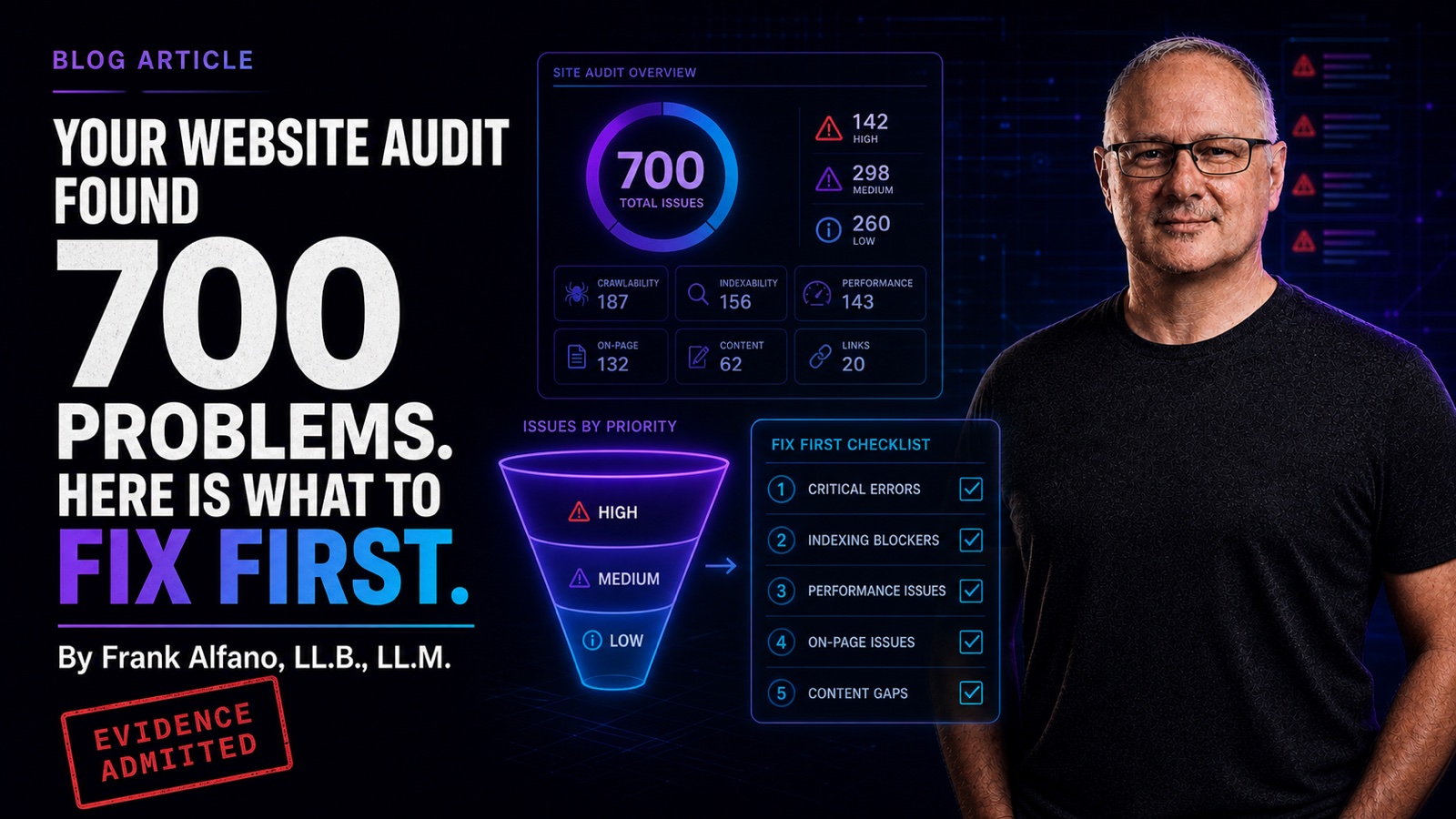
Want to know where you stand today? Get a free website audit — a plain-English PDF scoring your SEO, content, and technical health, with the issues ranked by what to fix first.
Common questions
Is SEO dead now that AI answers most searches?
No. SEO has changed jobs, not died. Branded, local, and high-intent searches still send real clicks — "lawyer near me" still ends in a phone call. And AI engines build their answers from fast, well-structured, authoritative websites, so technical SEO is now the qualifying round for AI visibility, not just Google rankings.
What's the difference between SEO, AEO, and GEO?
SEO (search engine optimization) ranks your website in traditional results. AEO (answer engine optimization) gets your content chosen as the direct answer in snippets and AI Overviews. GEO (generative engine optimization) gets you cited when ChatGPT or Perplexity writes its own answer. The same question-answering content feeds all three.
How do I get my business mentioned by ChatGPT and other AI tools?
Keep your business name, location, services, and credentials consistent across your website, Google Business Profile, directories, and social profiles. Publish content with first-hand expertise, real numbers, and direct answers under clear headings. And earn mentions beyond your own site — reviews, local press, and active social profiles — because AI engines weigh third-party corroboration heavily when deciding who to cite.
Do social media posts actually help my Google ranking?
Not directly. Google says social signals are not a ranking factor. But social posts appear in search results themselves, platform search bars are where younger customers start, and consistent posting drives branded searches, which still reliably produce clicks. AI engines also read active profiles as evidence a business is real.
What is zero-click search and why does it matter for my business?
A zero-click search ends on the results page: the searcher gets their answer from an AI Overview, snippet or map pack without visiting any website. About 68% of U.S. Google searches ended that way in early 2026. Being the source of that on-page answer is now the win, because the searcher learns your name there.
Want these in your inbox?
Roughly monthly. Unsubscribe any time.