You Don't Own Your Website. You're Renting It, and the Landlord Writes the Lease.
A certain kind of developer will tell you that owning your website is a beginner's idea. Here's what the people who believed that lost when they left, and ten questions that tell you in five minutes whether your website is an asset or a lease.
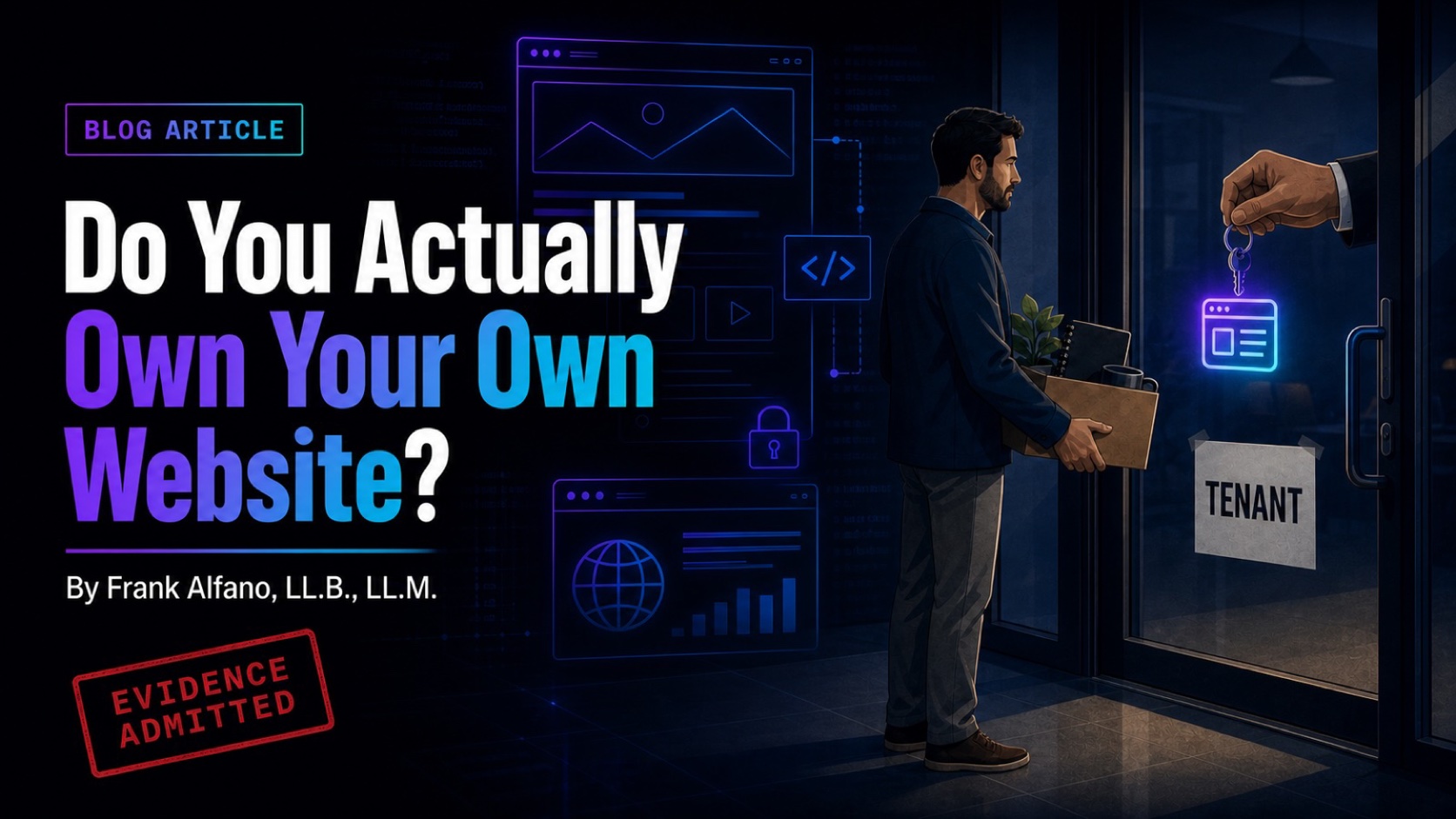
Every few months, someone lands in my inbox with the same story. They had a website for years. They paid for it every month, on time. Then they decided to leave their web developer. The reason doesn't matter; price, service, something they read on his Facebook feed. What they discovered, in the space of one phone call, was that they owned nothing. Not the code. Not the content. Sometimes not even the domain name their customers had been typing for a decade.
They didn't lose a website. They lost years. The rankings that took a decade to earn, the address printed on their business cards, the pages that had slowly climbed Google; all of it stayed behind with a developer they were done with, like furniture in an apartment they'd just been evicted from.
That's why "own your code, own your domain" is printed on my front door. It isn't a slogan I workshopped. It's a scar. Other people's scars, mostly, that I got tired of looking at.
Recently I watched a set-in-their-ways developer argue, at essay length, that wanting to own your website is a beginner's idea. That possession of your own code is "not much of a business outcome." That the question "who owns the code?" is one of the least interesting questions you can ask.
He's wrong, and I can prove it with his own favourite analogy. But first, let's talk about what he's actually selling, because once you see the model clearly, every argument for it translates itself.
The lease nobody reads
There is a kind of developer I think of as the Landlord Developer. The pitch sounds wonderful: pay a setup fee, then a comfortable monthly rent, and never think about your website again. The technology is "operated, maintained and continually developed on your behalf." You get the machinery without having to become the mechanic.
Notice what's missing from that pitch: the word yours.
Because here is the arrangement underneath the reassuring language. The platform is his. The code is his. The templates are his. The "ecosystem" is his. In the versions of this story that end up in my inbox, the domain, the one thing that should be as personal as your phone number, was registered by him too, in his name or his company's.
You're not a client. You're a tenant. And the test of any tenancy is not how it feels while you're paying. It's what happens the day you stop.
Move out of an apartment and you take your furniture. Move off a landlord's web platform and you take a memory. The site, the pages, the blog posts, the years of accumulated Google equity; none of it was ever yours. You didn't buy a website. You decorated his.
He's right about Microsoft 365. He just stopped the story halfway.
The rental crowd has one analogy they love above all others, and our set-in-their-ways developer reached for it on cue: businesses use Microsoft 365 every day without demanding Microsoft's source code. They use accounting platforms without wanting to run the accounting company's servers. Therefore, wanting to own your website is naive.
It's a tidy argument. It's also missing its second half, and the second half is the whole point.
Cancel Microsoft 365 tomorrow and Microsoft does not keep your documents.
Every letter you wrote, every spreadsheet you built, every file you created over ten years of subscribing: you export them, you walk away, and you open them in Google Docs or LibreOffice that same afternoon. Microsoft keeps its software. You keep your work. That separation is so fundamental that nobody even thinks about it. It's what makes the subscription safe to sign.
Nobody is asking for Microsoft's source code. They're asking to keep their own documents.
Now apply that to a website. Your website is not the software; your website is the document. It's the thing you made: your words, your photos, your services, your reputation, your years of search rankings. When you leave a landlord platform and the site stays behind, that isn't Microsoft keeping Word. That's Microsoft keeping every letter you ever wrote in it.
There's a name for a subscription where cancelling costs you everything you built while subscribed. It's called a lease. And a developer who compares himself to Microsoft 365 while running a lease is telling you something important, just not the thing he thinks he's telling you.
What ownership actually means (it's not becoming your own mechanic)
The favourite straw man of the rental model goes like this: lawyers and dentists and contractors don't want to become "part-time web developers, server administrators, security specialists and backup operators," so ownership is a burden dressed up as a virtue. Handing a client a zip file, the argument goes, is just transferring the maintenance burden to the customer.
Nobody I have ever worked with wants to be their own mechanic. That has never been what ownership means, and I suspect the people arguing against it know that.
When I say my clients own their code and their domain, here is what I mean, in full:
The domain is registered to them. Run a whois lookup on their address and their name comes back. Not mine. If I vanished tomorrow, the address on their trucks, their cards and their Google Business Profile still belongs to them, the way their phone number does.
The code and content are theirs, in writing. Every page, every image, every line of the site I built them is their property. They have a copy. It's not a mystery locked in someone else's platform.
Leaving is a decision, not a hostage negotiation. They can take the whole site to any developer in the country and it will run, because it's built on open, boring, portable technology: server-rendered code that any professional can pick up, not a proprietary platform that only works on the landlord's land.
And here is the part the straw man leaves out: I do everything their site requires anyway. Hosting, security, updates, backups, changes, the three-hundred small things. My clients get the same never-think-about-it experience the rental model advertises. The difference is invisible right up until the day it's everything: if we ever part ways, they leave with their property. All of it.
Ownership isn't a technical arrangement. It's the reason my clients never have to stay for the wrong reasons.
One article, worn by everyone
Now let's talk about what the comfortable monthly rent actually buys, because the economics of the landlord model force some ugly choices, and the ugliest one involves your content.
Here's how content works on a rental platform with dozens of tenants in the same industry. One article gets written; call it "Five Things to Know Before Your First Consultation." Then it gets adapted for every tenant on the platform: synonyms swapped, sentences reshuffled, your town's name dropped in where the last tenant's was. Fifty sites, one article, wearing fifty thin disguises. It's the only way the math works at that price, and I'll show you the math in a minute.
The problem is that Google has seen every thin disguise on the internet, roughly a trillion times.
People say "Google penalizes duplicate content," and that's not quite right; what actually happens is quieter and worse. When Google finds a cluster of near-identical pages, it doesn't punish anyone. It simply picks one version to index and filters the rest out of the results. No warning, no notice, no error message. One lottery winner ranks. The other forty-nine sites keep paying full rent for pages Google has quietly decided not to show anyone.
Your monthly fee is buying content. It's just not buying you content. There's a difference, and Google can tell.
An ecosystem that eats its tenants
The landlord model's proudest word is "ecosystem": an interconnected network of sites, all linking to one another, rising together. It sounds like strength in numbers. It's worth asking two quiet questions about.
First: what are those links worth? Links between websites owned and operated by the same company are the cheapest links on the internet, and Google discounts them accordingly; its spam policies have a name for excessive interlinking schemes, and it isn't "ecosystem." A link is a vote of confidence precisely because it comes from someone you don't control. Fifty sites on one platform voting for each other is one landlord voting for himself, fifty times. Google counts it about the way you'd expect.
Second, and more important: who else lives in the ecosystem? Look around at the other tenants. They're in your profession. Many are in your market. Which means the ecosystem's tenants are competing with each other: for the same searches, the same clients, the same page one, using the same templates and the same re-worn articles from the same content pipeline.
Page one of Google has ten spots. An ecosystem with dozens of tenants chasing the same queries cannot rank them all; someone wins and everyone else funds the infrastructure. And every incentive about who wins sits with the platform, not with you.
An ecosystem is a food chain. Before you join one, it's fair to ask where you sit on it.
What does $150 a month actually buy?
Let me be clear about something first: I charge monthly too. Monthly service is not the problem; websites genuinely need ongoing care, and anyone who sells you "done forever" is selling you neglect. The question is never whether you pay monthly. It's what the month buys, and who keeps what it produces.
So let's do honest arithmetic on the typical landlord tier: a setup fee around fifteen hundred dollars, then $100 to $200 a month.
Real SEO work is made of hours. Keyword research is hours. Writing an article that could actually rank is hours of work: researched, specific to your business, aimed at a query real customers type. Technical fixes are hours. Earning a legitimate link is hours. There is no version of this work that doesn't reduce to a skilled person's time.
Now spend your $150. Hosting comes off the top. Platform maintenance comes off the top. Support time, billing, the landlord's margin, all off the top. What's left over for growing your business specifically? At most, a couple of hours a month. And a couple of hours is exactly enough time to swap the synonyms in this month's shared article and drop your town's name into the template.
That's not an accusation. It's just division. The re-worn content and the self-linking ecosystem aren't corner-cutting on an otherwise good model; they are the model. They're the only way the price can exist.
Good work costs. Full stop. Anyone can undercut anyone on price; the honest question is what got removed to hit the number. When the answer is "everything specific to you," the cheap rent is the most expensive thing you're buying.
How a provider talks about clients is how they'll treat you
Here's a piece of due diligence nobody puts on the checklists: before you sign with any developer, me included, go read their public feed.
Some developers use theirs to share what they've built. Others use it differently. A client calls with a question the developer finds beneath him, and by evening there's a nine-paragraph public post explaining, in patient detail, why people who ask that sort of question are fools. No names, of course. Never any names. But the client who called that morning recognizes themselves immediately, and so does everyone else in town, which is rather the point.
Think about what that feed is telling you. It's a preview of your own future phone calls. Today it's someone else's "dumb question" being dissected for an audience. The day you ask yours, you'll already know where it might end up.
My policy is short enough to fit on a sticky note: what my clients ask me stays between us. There is no such thing as a stupid question from someone trusting you with their business. Confidentiality shouldn't be a courtesy reserved for one profession; it's the baseline of every professional relationship, including this one.
You can tell nearly everything about how a company will treat you by how it talks about the people already paying it.
Lawyers say they do law. Contractors say they do construction. I've always answered the same question a different way: technically, I do websites; really, I do people. If you can't do people well, you can't do business well, because at the end of the day every business is just how you treat the people in it. Demeaning your own clients in public isn't a personality quirk. It's a going-out-of-business sale, running in slow motion.
Ten questions to ask before you sign, or before you renew
You don't have to take my word for any of this. The rental model can't survive plain questions asked in plain daylight, so here are ten. Ask them of any developer, including me. Ask them before you sign, or, if you're already years into a monthly arrangement, before you renew.
1. Whose name is on my domain registration? Run a whois lookup right now; it's free and takes ten seconds. If the answer isn't your name or your company's, stop reading this list and go fix that first. Everything else is furniture; this is the deed to the land.
2. If I leave, exactly what do I receive? Not "we'll work something out." Exactly. Files? Database? Images? Content? Get the list in writing before you need it.
3. Is my content written for me, or adapted from content used on other clients' sites? Watch the face when you ask this one.
4. Are any of your other clients my direct competitors? And if so: when we're both chasing the same search, who decides which of us wins?
5. Who owns the copyright to my site's design and content, and where is that written down? "Don't worry about it" is an answer. It's just not a good one.
6. What happens to my Google rankings if I move? If the honest answer is "you'd start over," you don't have rankings. Your landlord does.
7. Can I see the exit clause before I sign? The quality of an agreement is measured at the exit, never at the entrance.
8. Where is my site hosted, and can I have access? You're allowed to know where your own property lives.
9. What exactly does the monthly fee buy, itemized? Hours, deliverables, and outcomes, not "maintenance and peace of mind."
10. Can you introduce me to a client who left? Not a testimonial from a happy current customer; a former one. What did they take with them? How did it go? A provider whose ex-clients will vouch for the divorce is a provider you can safely marry.
If you'd like a head start on the technical half of this, my free website audit will tell you in about five minutes whether your website is an asset or a lease, including whose name is actually on your domain. No charge, no obligation, and whatever it finds stays between us. That last part, as you now know, is not something to take for granted.
Common questions
Do I actually own my website if an agency built it?
Only if three things are true: the domain is registered in your name, you have (or can get) a complete copy of the site's code and content, and your agreement says in writing that the design and content are your property. Many agencies satisfy none of the three. Who built the site matters far less than what the paperwork and the domain registration say. Check the whois record for your domain today; it's free and takes ten seconds.
What happens to my website if I leave my web developer?
It depends entirely on the arrangement you signed. If you own the domain, the code and the content, you take everything to a new developer and your site keeps running; your rankings, address and content come with you. If your site lives on a proprietary platform you rent, you typically lose the site and all its content the day you cancel, and you start again from zero. The time to find out which arrangement you have is before you want to leave, not after.
Should my domain name be registered in my name or my web designer's?
Yours. Always, without exception. Your domain is your business's permanent address; it's on your trucks, your cards and your Google Business Profile, and every ranking you earn is attached to it. A developer can manage your domain on your behalf, but the registrant must be you or your company. If a provider insists on registering your domain in their own name, that is the loudest warning a provider can give you.
Is duplicate content bad for SEO?
Yes, though not the way most people think. Google doesn't issue a "duplicate content penalty"; it does something quieter. When it finds several near-identical pages, it picks one version to index and silently filters out the rest. If your site's articles are lightly rewritten versions of content used on dozens of other sites, your pages are likely in the filtered group, invisible in results no matter how long you keep paying for them. Content only builds your rankings when it's written for you.
What questions should I ask before signing a monthly website contract?
The essentials: Whose name will be on the domain registration? If I leave, exactly what do I receive, in writing? Is my content original or adapted from other clients? Are your other clients my competitors? What does the monthly fee buy, itemized? And what does the exit clause say? A trustworthy provider answers all six without flinching. Evasion on any of them, especially the domain and the exit, tells you everything you need to know.
Want these in your inbox?
Roughly monthly. Unsubscribe any time.