How to Get ChatGPT to Recommend Your Business by Name
Ask ChatGPT who builds websites for law firms in Ontario. There is no page two. Two to four businesses get named and everyone else gets nothing. Here is how engines actually assemble that list, and why most of the work to get on it happens on other people's websites.
Ask ChatGPT who builds websites for law firms in Ontario. Go ahead, I'll wait.
Whatever names came back, notice what just happened. You didn't get ten links to choose between. You got a short list, assembled and endorsed by something the person asking already trusts. There is no page two. There is no scrolling past the ads. Two to four businesses got named, and everyone else got nothing.
That's the fight now, and the economics are unusual. Ahrefs measured AI referrals producing 0.5% of their traffic and 12.1% of their signups, which works out to roughly 24 times the conversion rate of ordinary search traffic. The reason is obvious once you see it: people arriving from an AI recommendation were pre-sold before they clicked. They're not comparing you. They're confirming you.
So: how do you get named?
How AI engines actually assemble an answer
You can't optimize a system you don't understand, and most advice about "AI SEO" skips this part entirely.
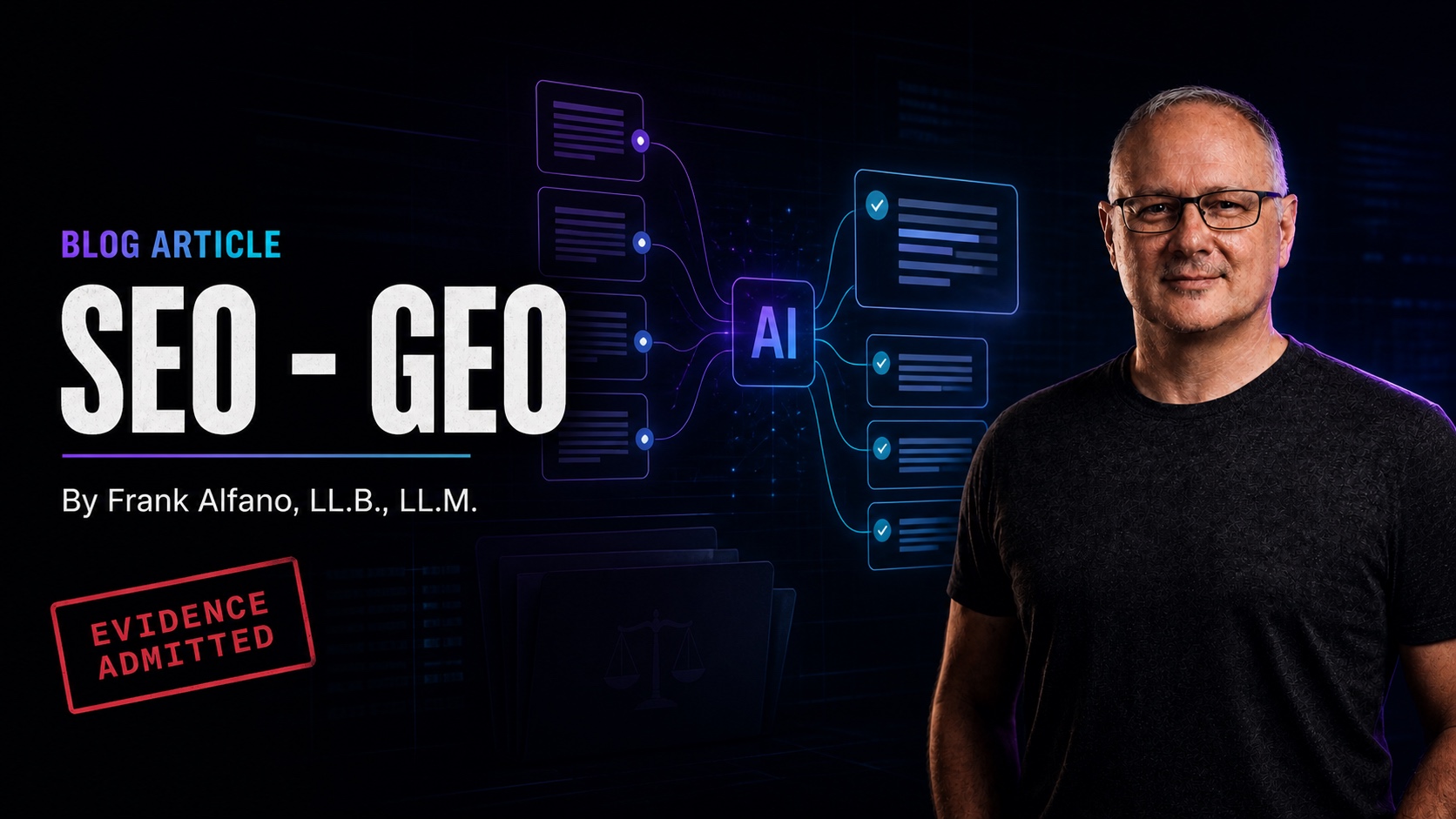
Every major engine, AI Overviews, ChatGPT search, Perplexity, Gemini, Copilot, uses the same broad architecture: retrieval-augmented generation. The model doesn't answer purely from memory. It interprets your question and rewrites it into several search-engine-style queries, a process called query fan-out. It retrieves candidate documents from a web index, Google's own for AI Overviews and Gemini, Bing's for Copilot and ChatGPT, a hybrid for Perplexity. It re-ranks and selects a handful of passages. It writes an answer grounded in those passages. Then it cites what it leaned on.
Two other channels operate alongside. The model's training memory, which is slow-moving and shaped by the durable public record. And, for recommendation questions specifically, heavy reliance on aggregators: review sites, "best X" listicles, Reddit threads, directories. The model behaves like a cautious human researcher looking for third-party consensus rather than taking a vendor's word for it.
That last behaviour has a measurable consequence. Roughly 85% of AI citations point to third-party sites rather than the brand's own. Which means most of the work is not on your website.
The seven levers
Be retrievable. You must be indexed by Google and Bing, and reachable by the AI crawlers. Verify Bing Webmaster Tools, which most sites never do, and check your robots.txt allows GPTBot, ClaudeBot and PerplexityBot plus the search-time fetchers OAI-SearchBot and Claude-SearchBot. Your content also has to be in server-rendered HTML, because many of these fetchers don't run JavaScript. I covered both in the technical article.
Rank classically. Retrieval is ranking-like. Studies of AI Overview citations consistently show heavy overlap with top organic results. Everything in the first seven articles of this series is the groundwork. There's no shortcut around it.
Be quotable at the passage level. The unit of selection is the passage, not the page. Self-contained, heading-anchored sections that state a complete answer survive retrieval chunking. This is the same skill as winning a featured snippet, which is why I put that article first.
With one addition. Research out of Princeton and collaborators quantified what generative engines favour, and adding statistics, direct quotations and cited sources lifted source visibility by roughly 30 to 40%. Concrete numbers and sourced claims get cited at measurably higher rates than confident prose. "Saves time" loses to "saves three hours a week."
Be entity-clear. The engine has to resolve who you are. Consistent name and description everywhere, Organization schema with sameAs links, a real About page, presence in the knowledge bases. An ambiguous entity doesn't get recommended, because the model can't tell whether three mentions are one business or three.
Seed the consensus layer. For "best X" and "who should I hire" questions the engine reads aggregators, so your work is getting into the credible listicles, comparison posts, review platforms and directories for your category, described accurately. Plus genuine presence where models demonstrably look: Reddit above all, thanks to licensing deals and constant retrieval, then Quora, industry forums and YouTube.
Authentic participation only. This is reputation work, not posting. Astroturfing gets spotted by the community long before a model cares, and communities are unforgiving about it.
Stay fresh. Retrieval favours current content. Visible updated dates, honest lastmod values, and periodically refreshed money pages keep you in candidate sets.
Cover conversational long-tails. Chat queries are specific and compound: "best web design agency for a restaurant in Niagara under $5k." Nobody types that into Google. The long-tail depth from your keyword map is what widens the net of prompts you can be retrieved for.
The build list
Levers are abstract. Here's what to actually make.
One claim, repeated identically, everywhere
Distil your positioning into a single specific provable claim, in the shape of one thing plus proof plus proof plus proof. Something like "Ontario web design agency that ships in 14 days, 200+ launches, 5.0 Google rating, Hamilton-based."
Then repeat it verbatim everywhere your business appears. Site, Google profile, LinkedIn, X, Instagram, YouTube, TikTok bios, directories, review-site profiles, email signature, podcast guest bios.
This feels wrong to marketers, who are trained to vary their copy. Resist that. Language models build their description of your brand by consolidating what they read across sources. A consistent claim survives consolidation. Ten clever variations blur into nothing, and the model ends up describing you vaguely, or not at all.
The version of you repeated most consistently across trusted sites is the version the AI repeats.
Three page types AI quotes constantly
Publish "best X" lists, "X vs Y" comparisons, and "X alternatives" pages. These map exactly onto the recommendation-shaped questions people ask chatbots, and engines quote them relentlessly.
The trust rules are not optional. Include competitors and assess them honestly, including where they beat you. Use verified current prices with an attribution line like "prices verified August 2026." Make every table row self-explanatory. Advertorial versions of these pages read as advertising to a model trained on millions of honest ones, and they get skipped.
Yes, this means writing a comparison page that recommends a competitor for some buyers. That's the price of admission, and it's also just true.
Real buyer questions, not keyword-tool questions
Your sales calls, support tickets, pre-purchase emails and reviews contain the exact phrasings buyers type into chatbots. Especially the honest three-star reviews, yours and your competitors'.
Bucket them into competitor terms ("Squarespace alternatives"), problem terms ("my website form keeps missing enquiries"), and fit terms ("website for a two-person paralegal firm"). Skip purely educational questions with no buying intent. This is keyword research from a source no tool has.
The quotability test, on every page that matters
Cover the page except one paragraph. Can that paragraph alone answer a real question, with the subject named rather than "it," a specific number instead of a vague claim, and a source where one's needed? If not, it won't survive chunking. Run it at the editing stage, every time.
Placements on other people's domains
Since roughly 85% of citations point elsewhere, this is where the leverage is.
A podcast episode, a YouTube collaboration or a newsletter feature creates a permanent page on someone else's trusted domain, describing you in their words, re-crawled indefinitely. Pitch small and mid-size shows in your field. Make your own videos answering buying questions, because transcripts are retrievable text.
A modest newswire release for something genuinely newsworthy, a launch, a milestone, a partnership, gets syndicated onto news domains AI engines crawl and trust. Front-load who and what and why in under 50 words, write it in plain third-person fact, include two or three links to the pages you want cited. Use it sparingly and honestly, because newswire spam is detectable noise.
This reframes link building. The link was the old prize. The durable third-party description is the new one.
Measuring it
Build a standing battery of 20 to 50 prompts that matter to your business. "Best [service] in [city]," "how much does [service] cost," "[your brand] reviews," "alternatives to [competitor]."
Run them monthly across ChatGPT, Perplexity, Gemini and AI Overviews. Log three things: whether you were mentioned, how you were described, and which sources got cited.
That third column is the valuable one. The cited sources are your target list. If Perplexity cites a directory you're not in when recommending your competitor, you now know precisely where to spend the next hour.
Also segment your analytics for referrers from chatgpt.com, perplexity.ai, gemini.google.com and copilot.microsoft.com. The traffic will be small. Watch what it does after it arrives, because that's where the 24x shows up.
And watch your server logs for AI crawler activity. Being crawled is the leading indicator of being citable.
If you'd rather not run the battery by hand, that's exactly what my AI visibility check does: it asks the engines your money questions and emails you what they said, including who they recommended instead of you.
The honest summary
Roughly 70% of getting cited by AI is just excellent conventional SEO. Another 20% is answer-shaped content. Only about 10% is genuinely AI-specific work: crawler access, entity hygiene, consensus seeding, statistics-rich writing, and the measurement loop.
Anyone selling you "AI SEO" as a separate discipline requiring a separate subscription is selling you the 10% and hoping you don't ask about the other 90%. You never switch from SEO to AI optimization. You extend.
What's genuinely new is where the work happens. Most of it is now off your website, on other people's domains, in review corpora and forum threads and comparison pages you don't control. That's uncomfortable for anyone who thinks of their site as the whole asset. It's also why the businesses winning here are the ones with actual reputations, which no subscription can manufacture.
Common questions
What is generative engine optimization?
Generative engine optimization is the practice of getting your business cited and recommended by AI answer engines like ChatGPT, Perplexity, Gemini and Google's AI Overviews. It extends conventional SEO rather than replacing it: roughly 70% is excellent SEO, 20% is answer-shaped content, and 10% is AI-specific work like crawler access, entity consistency and consensus seeding.
How do I get ChatGPT to recommend my business?
Be retrievable (indexed in Google and Bing, AI crawlers allowed, server-rendered HTML), rank well conventionally, and seed the third-party sources ChatGPT reads for recommendations: review platforms, credible "best in [city]" listicles, directories and Reddit. Roughly 85% of AI citations point to third-party sites, so most of the work happens off your own website.
Is GEO different from SEO?
It's an extension, not a replacement. Retrieval works like ranking, so pages that rank well organically are far more likely to be cited by AI engines. The genuinely new work is narrow: allowing AI crawlers, keeping your entity description consistent everywhere, writing statistics-rich quotable passages, and building presence in the aggregators engines read for recommendations.
Does AI search traffic actually convert?
Unusually well. Ahrefs measured AI referrals producing 0.5% of their traffic and 12.1% of their signups, roughly 24 times the conversion rate of ordinary search visitors. The reason is that people arriving from an AI recommendation were pre-sold by the recommendation itself, so they arrive confirming a choice rather than comparing options.
How do I track whether AI engines mention my business?
Build a battery of 20 to 50 prompts that matter to you, then run them monthly across ChatGPT, Perplexity, Gemini and AI Overviews, logging whether you were mentioned, how you were described, and which sources were cited. Those cited sources are your target list for where to build presence next.
Want these in your inbox?
Roughly monthly. Unsubscribe any time.