SEO is just the beginning, and the phone call is where marketing ends
A page that ranks gets you considered. It does not get you called. Here are the stops a client makes between the search and the call, and the list to ask your provider for every month.
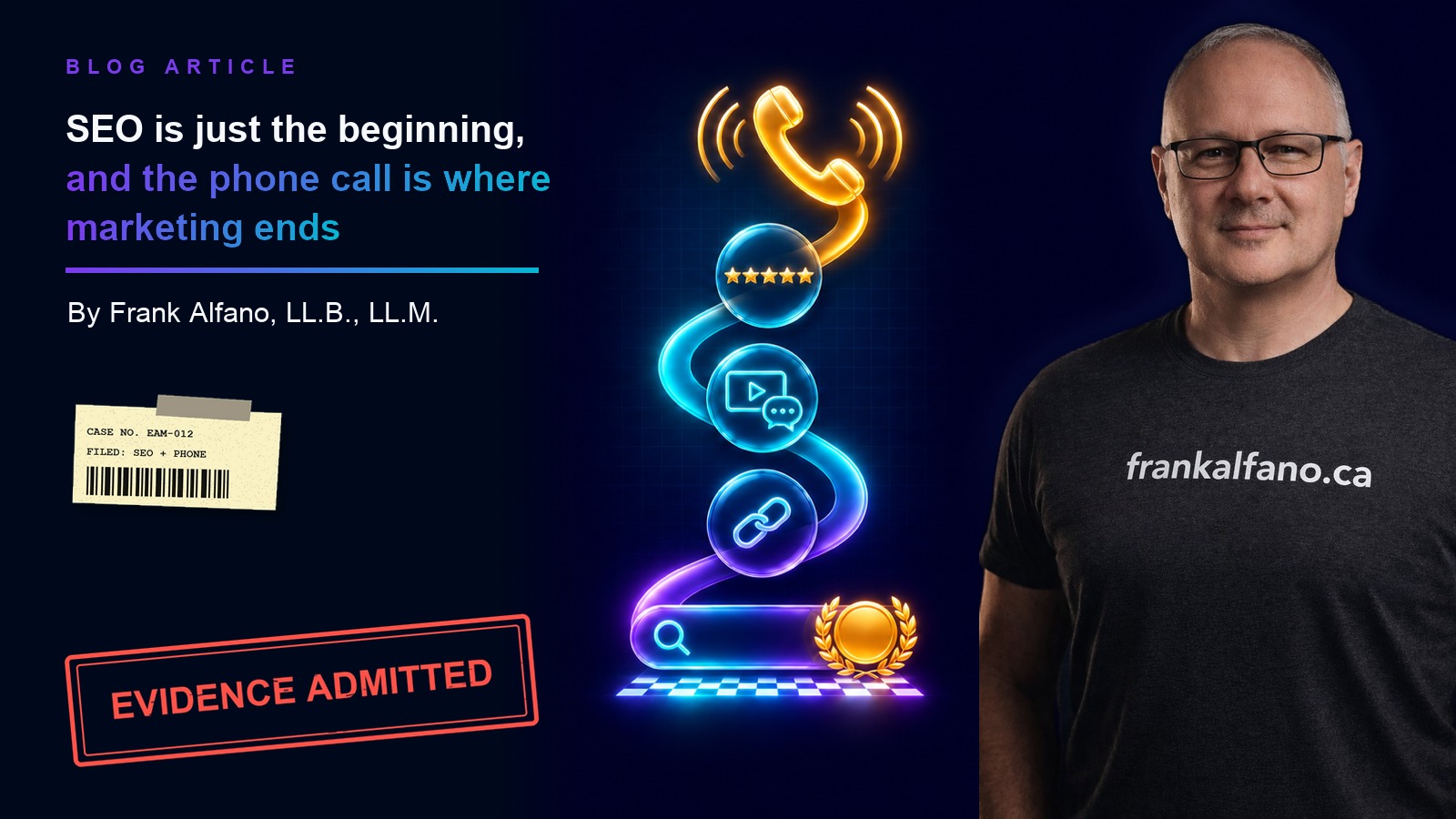
A ranking has never picked up a phone. SEO gets a practice found and considered, and then a stranger spends a few minutes checking who else vouches for you before deciding whether to call. It starts with SEO and ends with conversion, and most of what happens in between happens somewhere other than your website.
That gap is where SEO and marketing part ways. If you are a lawyer or a paralegal, a dentist, an accountant or anyone else whose clients look you up before they call, here are the stops a prospective client makes between the search and the call, what each stop asks of you, and the list to hold any provider to every month: what was done at each stop, and how many calls came in.
Where SEO stops
Our article on why a website and marketing are not the same thing ended at the website. It set out ten jobs that matter most to where a page ranks, the four a competent build finishes and the six that never finish. This one starts at the point where a ranking has been won.
Winning it is hard enough. Ahrefs took the roughly 14 billion pages in its Content Explorer index for its search traffic study, published in December 2023, and reported that "96.55% of all pages in our index get zero traffic from Google." A page that ranks and gets visits is already the exception.
Then the visitor still has a decision to make. A page that ranks gets a professional considered. It does not get them called. Our article on why ranking first can still lose the client covers that gap from the other side. Between the two, the client asks two questions that your own website cannot settle on its own authority: who else says you are good, and is there a real person behind the name?
Your website can answer both, and the client will discount the answer, for the same reason a reference letter loses something when the candidate wrote it. The proof the client wants sits on other people's websites, on video, in reviews, and in a feed that shows somebody turned up this month. Getting the practice into those places is marketing.
What a client does between the search and the call
BrightLocal's Local Consumer Review Survey 2026 asked a representative panel of 1,002 US adults how they check out local businesses, and published the results in February 2026. It is an American survey, and it covers local businesses in general rather than professional practices. The path it describes will still be familiar to anyone who has been looked up before a first appointment.
97% of the people surveyed read reviews for local businesses, and the average consumer uses six different review sites. Google is still the most used place to read them, at 71%, down from 83% in 2025. BrightLocal's chart of the top review sites puts Facebook at 49%, YouTube at 43% and the Better Business Bureau at 29%. Use of "ChatGPT and other generative AI tools for local recommendations" rose from 6% to 45% in a year.
The survey then asked what people do after reading a positive review. The answers add up to more than 100%, so many people did more than one thing:
- 54% check the business's website.
- 37% read more reviews on different review sites, and 37% read more on the same site.
- 24% visit the business's social media channels.
- 22% keep searching for other businesses.
- 20% contact the business.
Read that list from the client's chair. A good review sends half of them to your website and more than a third to other review sites. Your website is one stop among several, and the Better Business Bureau, at 29%, is one of the review sites they use. Some of them, after all that reading, go looking at the next name.
So the path runs like this: a search, a ranking, a look at your site, a look at who else vouches for you, a look at whether a real person is there, and then a call or a click on someone else.
Other sites that vouch for you
When a prospective client wants a second opinion about you, they find it on other people's websites: a professional directory, the Better Business Bureau, a Yelp page, a local news story, an article that cited you. Each one is a stranger's site saying you exist and you are worth mentioning.
What Google says about prominence
Google's help page on how local results are ranked says, "Local results are mainly based on relevance, distance, and popularity." "Prominence means how well-known a business is," the page says, and "This factor's also based on info like how many websites link to your business and how many reviews you have." By Google's own account, other websites linking to you count in its local results.
The wider web shows the same pattern. In the Ahrefs study, about 20 million pages had no referring domains, meaning no other website linked to them, "yet only 2,997 of them get more than 1K search visits per month. That's roughly 1 in every 6,671 pages with no backlinks." Ahrefs is careful with the finding and so should we be. The traffic numbers are its own estimates, from one tool's index, and the article says plainly that "correlation does not imply causation." Read it as the odds in one index.
Earned, not bought
Google's spam policies define link spam as "the practice of creating links to or from a site primarily for the purpose of manipulating search rankings," and the first example listed is "Buying or selling links for ranking purposes." The local ranking page adds a sentence worth showing anyone who offers a shortcut: "There's no way to request or pay for a better local ranking on Google."
So the work is slow and specific. For our clients it means the Google Business Profile, listings on Yelp, the Better Business Bureau and the trade or professional directories that fit the practice, and link outreach, which is the job of getting relevant sites to cite something on yours that is worth citing. We also do Reddit work for clients. Our guides to getting backlinks for a small business and to Google Business Profile optimisation cover each in more depth.
A website cannot do any of this by itself. It cannot create a listing on someone else's site, and it cannot ask another site for a link. A person has to.
Video and social posts show somebody is there
The second question a client brings is whether a person is behind the name. Hiring a lawyer, a dentist or an accountant means hiring a person, and clients want to see and hear that person before they ring.
What video and posts do, and what they don't
Start with the limit. We do not claim that social posts, YouTube videos or reviews on other sites move your website up Google's rankings, and I would be wary of anyone who sells them that way. What they do is answer the client's question about who you are, and give AI answers more places to find you.
On that second point, Ahrefs tracks which websites Google's AI Overviews cite, across more than 3 million US queries. Its list of the 50 most-cited websites in AI Overviews, updated 3 November 2026, gives YouTube 24.5% of the citations, Reddit 18.1% and Facebook 12.4%. Ahrefs defines that share as "a domain's citations as a percentage of the summed citations of the top 50 most-cited sources," so these are shares of the top 50, not of every citation Google shows, and they are US figures. They still mean that a practice with a useful YouTube video has one more place an AI answer can point to.
What a quiet feed tells a client
In the BrightLocal survey, 24% of people visit a business's social channels after reading a good review. When they arrive, the feed answers a question they did not ask out loud: is anyone home? A page with a post from this week says yes. A page whose last post is two years old leaves a stranger wondering whether the practice is still open, and that is a poor thought to plant just before they decide whether to dial.
Video without filming every week
For most professionals the obstacle is the camera. The material already exists: you answer the same client questions every week. We write the scripts from what your audience is searching for, and we make social posts, carousels, reels and short-form video. Our marketing page prices short-form video at $250 per video plus HST. We also do character generation.
If filming is the part that never happens, our digital cloning service lets you record once. Setup is $1,000 one-time when you record yourself, or $1,500 when we come to you, plus HST, and short-form videos using your approved clone are $150 each. You approve every video before it is published.
A website can host a video. It cannot script one, film one or post it where your clients scroll.
Reviews and social proof
Social proof is the evidence that other people chose you and were glad they did, and reviews are most of it. In BrightLocal's survey, 85% of consumers say positive reviews make them more likely to use a business, 74% look for reviews written in the last three months, and "47% of consumers won't use a business with fewer than 20 reviews."
I put it this way: a lack of social proof hurts your digital footprint. I mean the footprint a stranger or an AI tool finds when they look you up, and the trust and the calls that go with it. A thin footprint gives a careful client fewer reasons to call you, and an AI answer fewer places to find your name.
There are rules about how you get reviews. Google's page of tips to get more reviews says "you can ask customers to visit a Google link or scan a QR code," and advises, "As best practice, reply to reviews and share your perspective." Google's prohibited and restricted content policy says merchants may not offer incentives "such as payment, discounts, free goods and/or services" in exchange for a review, and may not "Discourage or prohibit negative reviews, or selectively solicit positive reviews from customers." Ask every client, not only the happy ones, and pay nobody.
If you are a lawyer or a paralegal, your regulator's marketing rules also apply to how you ask for reviews and how you use them, and other regulated professionals should check their own regulator's rules before they start.
A website can display a review. It cannot ask a client for one.
Count the calls with call tracking
Every stop so far is effort. The call is the result. If nobody can say which effort produced the call, nobody is managing the marketing, and the monthly report becomes a description of activity.
Call tracking is how you count. It is included with any marketing subscription you hold with us, at no extra charge, and it works like this: each campaign gets its own phone number, that number forwards to your own line, and every month you get a statement of the incoming calls. The caller dials, your phone rings as it always does, and the call lands on a list. If you only want a number pointed somewhere, a standalone number is $5 a month plus HST, with the same monthly statement.
For a paralegal client, we put a dedicated number on a campaign, forwarded it to his own phone, and sent him a monthly statement listing every incoming call. That is the whole mechanism. It replaces a guess about whether a campaign made the phone ring with a list he can read.
Where the tracked number goes, and where it doesn't
A tracked number belongs on a campaign: an ad, a landing page, a video description. Your main number stays the same on your Google Business Profile and on every directory listing, so your name, address and phone number match everywhere a client looks you up.
That is our practice, and Google's guidelines for the number on your Business Profile point the same way. They ask for "a phone number that connects to your individual business location," and say "The phone number must be under the direct control of the business."
A website can show a phone number. It cannot tell you which piece of marketing made it ring.
A website for rent is not marketing
This section is my opinion about a way of selling. It is about a model, and I am naming no company.
On the website-for-a-monthly-fee model, the fee buys the website. I call it a website for rent. Many of these providers list ads, social posts or SEO as add-ons, and some of that work is done well. But none of the stops in this article is in the monthly fee unless you ask for it, and unless it shows up on a monthly list of work done.
I don't think a provider can fairly call it marketing, or SEO, when the website is the only thing delivered. One site, the same pages used for every customer in a trade, and nothing built around it: no links earned, no videos, no posts, no listings, no way to count calls.
The test takes one email. Ask for last month's list:
- Links earned, and the sites they came from.
- Listings created or corrected.
- Videos published.
- Posts published.
- Calls received on a tracked number.
An empty list is the answer. It is also the shortest report you will ever be sent. Our article on what evidence shows that SEO work was completed sets out what a real list looks like, and the same test applies to us.
To be fair to the model, a rented template site suits a practice that lives on referrals and only needs a credible brochure. If your phone rings because past clients send their friends, a clean site with your hours, your services and your number may be all you need. It is a brochure, and a good one can be worth paying for.
SEO and marketing, start to finish
SEO and marketing become one job when somebody does all of it: the ranking, every stop after it, and the count at the end. That is what we sell, and the prices are on our pricing page in CAD, plus HST.
- We build the website. Our pricing page says "Ownership transfers on full payment, subject to pre-existing and third-party licences," and you can get a downloadable ZIP of your website code. Hosting is $25 a month.
- Off the site, we work on your Google Business Profile, your listings on Yelp, the Better Business Bureau and the directories in your trade or profession, and link outreach.
- We make social posts, carousels, reels, short-form video and cloned avatar video, and we write the scripts.
- Call tracking comes with any marketing subscription, at no extra charge, with a monthly statement of incoming calls. A standalone number is $5 a month plus HST, with the same statement.
- Marketing packages start at $1,195 a month with articles, social posts and weekly SEO reporting, whether or not we built your website.
If you want to know where your website stands before you decide on the rest, start with our free website audit. You enter your address, and we email you a plain-English PDF of what the check found on that page.
Common questions
Is SEO enough to get clients?
No. SEO gets a practice found and considered, and the client still has to decide to call. Before they do, most people read reviews, check other sites that mention the practice and look for signs a real person is behind it. In BrightLocal's 2026 survey of 1,002 US adults, 54% checked a business's website after reading a positive review and 20% contacted the business. The work between the ranking and the call is marketing.
What is the difference between SEO and marketing?
SEO is the work that gets your pages found in search: matching what people look for, publishing useful content, earning links and fixing technical problems. Marketing covers the whole path to a new client, including SEO, reviews, directory listings, video, social posts and counting the calls that result. SEO starts the process. Marketing ends when the phone rings and someone can say what made it ring.
Do other websites linking to you still matter?
Yes. Google's help page on local ranking says prominence is partly based on "how many websites link to your business." Ahrefs' 2023 search traffic study found that of about 20 million pages with no referring domains, only 2,997 got more than 1,000 search visits a month, a correlation in its own index rather than proof. Links have to be earned: Google's spam policies treat buying or selling links for ranking purposes as link spam.
Do social posts and video help a practice get calls?
They can, by helping a client decide to call rather than by moving your rankings: we don't treat social posts as a way to rank your website, and we don't sell them as one. Posts and video help in two ways. They show a prospective client that a real person runs the practice, and they give AI answers more places to find you: Ahrefs' November 2026 list of the sites Google's AI Overviews cite most puts YouTube, Reddit and Facebook at the top.
What is call tracking?
Call tracking gives a marketing campaign its own phone number, which forwards to your normal line, so every call that comes in through it can be counted. At Exhibit A Media it is included with any marketing subscription, and the client gets a monthly statement of incoming calls. A standalone number is $5 a month plus HST, with the same statement. The practice's main number stays the same on its Google Business Profile and directory listings.
Should a professional practice be on YouTube?
Yes, if you have client questions worth answering on camera and can keep publishing. A useful video shows a prospective client how you explain things before they call. In Ahrefs' November 2026 US data, YouTube received 24.5% of the citations going to the 50 sites Google's AI Overviews cite most. Video does not replace reviews or referrals, and a digital clone can take the filming off your calendar.
What is social proof?
Social proof is the evidence that other people chose a business and were satisfied: reviews, ratings, mentions on other websites and listings with organisations such as the Better Business Bureau. Prospective clients read it before they call. In BrightLocal's 2026 survey of US consumers, 85% said positive reviews make them more likely to use a business, and 47% said they won't use one with fewer than 20 reviews.
Want these in your inbox?
Roughly monthly. Unsubscribe any time.