Google's AI does the searching now. Here is what that changes about SEO
A client asks Google one question, and Google's AI runs many narrower searches before it answers. How many of those searches find you now counts for more than a few places on one keyword.
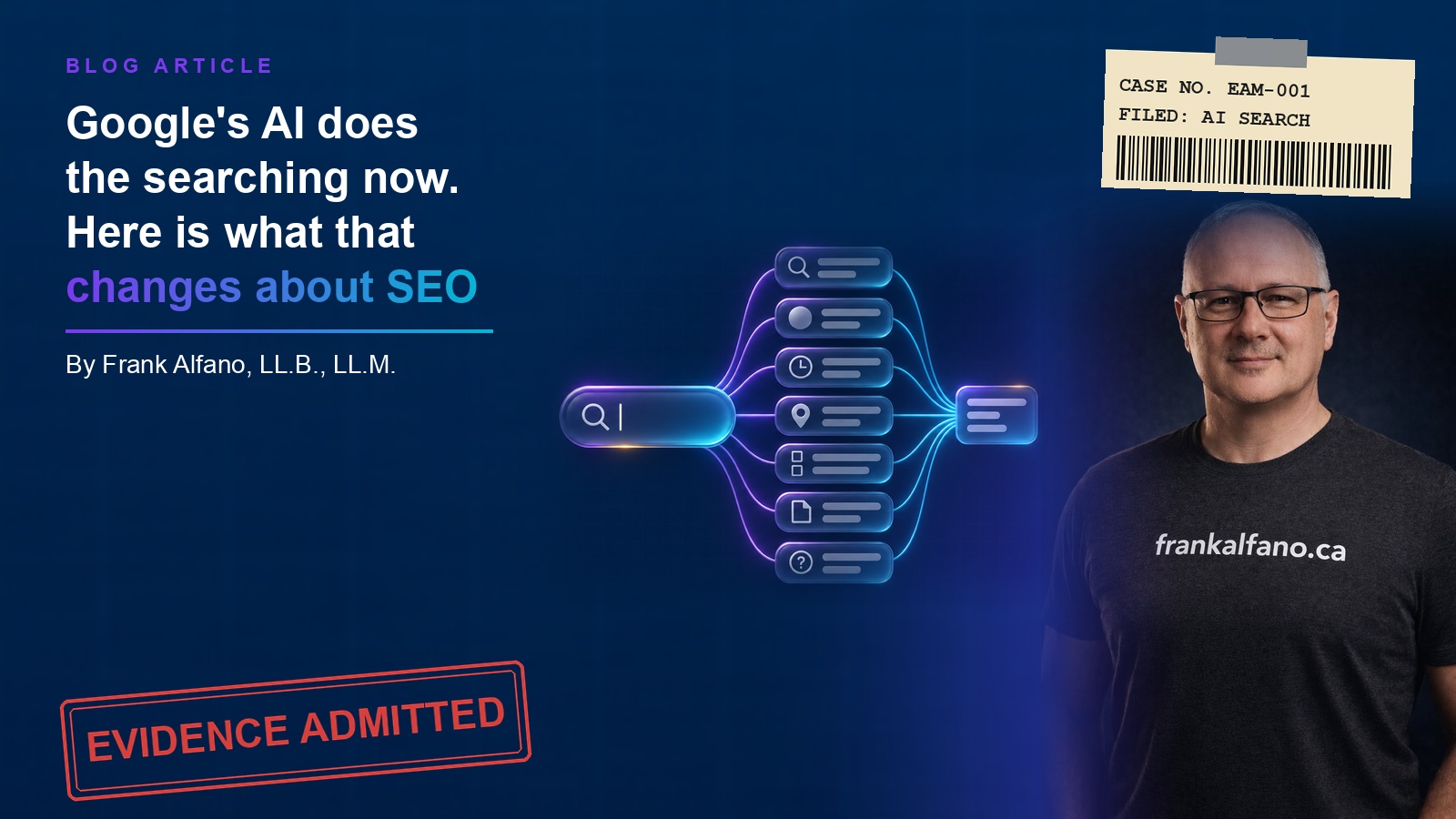
When a client asks Google's AI one question, Google asks the web many. Most professional websites are built to answer only the first one, and the AI is out there reading for the rest. On 12 November 2026 Google moved Search onto a new model, Gemini 4 Hydrogen, and its Gemini 4 Hydrogen announcement says the model "supercharges our query fan-out technique in Search, connecting you to a broader range of helpful links than before."
That changes what AI SEO has to do. If you are a lawyer or a paralegal, an accountant, a dentist or anyone else whose clients look you up before they call, here is how Google's AI turns one short question into many narrower searches. That is why the number of those searches that find you now counts for more than a few places on one keyword. After that comes the work that earns it, and which of our services does that work.
How search used to work, and what SEO was built for
For years a search went like this. A person typed three or four words, "family lawyer Hamilton" or "dentist near me", looked at the first few results and clicked one. If the page looked right, they picked up the phone. If it didn't, they pressed the back button and tried the next name.
SEO grew up around that person. The unit of work was a keyword and the unit of success was a position. You picked a phrase, built a page for it, earned some links to it and watched it climb. Moving from fifth to second on "employment lawyer Toronto" was worth paying for, because the searcher only looked at a handful of results, and second got more of the clicks than fifth.
The searcher who wanted more than a name did the extra work themselves. They searched once for the price, again for how long it would take, again for the form they needed, and once more for someone nearby. Each of those was a separate search, and each one was a separate chance for a different website to win.
That model measured one search, typed by one person, who read very little. Google now describes a different person. Its Search Central page on AI features and your website says that in AI Mode, "People can ask nuanced questions that might have previously taken multiple searches." The four searches the client used to run in a row are now one question, and Google runs the rest.
What Google's AI does with your question
Google calls it query fan-out, and it has described it in its own words more than once. When it introduced AI Mode in March 2025, Google's Search blog said the feature "uses a 'query fan-out' technique, issuing multiple related searches concurrently across subtopics and multiple data sources and then brings those results together to provide an easy-to-understand response."
In May 2025, Elizabeth Reid, Google's head of Search, put it more plainly in Google's May 2025 AI Mode update: AI Mode works by "breaking down your question into subtopics and issuing a multitude of queries simultaneously on your behalf." The same post says Deep Search, the research version, "can issue hundreds of searches."
It is not only AI Mode. Google's AI features page says "Both AI Overviews and AI Mode may use a 'query fan-out' technique," and that while an answer is being written, Google's models "identify more supporting web pages," which lets Google show "a wider and more diverse set of helpful links" than a classic search. Note the word "may". Google does not say that every answer fans out.
One question, many searches
Here is how that might look for a landlord whose tenant has stopped paying rent. The landlord types "paralegal for an LTB hearing". Five words, the kind of search SEO was built for. To answer it well, Google's AI has to work out what the landlord needs, and the questions behind those five words look something like this:
- Can a paralegal represent a landlord at the Landlord and Tenant Board?
- How much does a paralegal charge for an LTB hearing?
- How long does it take to get a hearing for unpaid rent?
- Which form starts an eviction for non-payment?
- What happens if the tenant does not show up to the hearing?
- Which paralegals near me handle landlord cases?
Google does not publish the searches it runs for an answer, so I wrote that list myself as an illustration. Ahrefs, which studies AI Overviews at scale, makes the same point in its March 2026 study: "Google doesn't expose the simulated fan-out queries they generate for each AI response." The shape is still the one Google describes: one question, broken into subtopics, each searched on its own.
The same happens outside law. A business owner types "accountant for a small corporation", and the questions behind it might be about fees, year-end deadlines, whether the accountant also does payroll, and who is close by. A patient types "emergency dentist", and the AI might go looking for opening hours and whether the practice takes new patients.
Those narrower searches are long tail keywords
Each of those narrower questions is what SEO people call a long tail keyword: a longer, more specific search that fewer people type, with a clearer idea of what the person wants. On their own, most long tail keywords look too small to bother with. Under fan-out, they are where the answer gets assembled.
A page that answers "how long does it take to get an LTB hearing for unpaid rent" in plain words is a page Google's AI can read while it builds the answer to "paralegal for an LTB hearing", even though the landlord never typed the long version. Google's AI may be the first visitor in a long while to read your fees page and your FAQ in the same sitting, and it does so without being asked.
Why one ranking matters less, and why it still matters
If the answer is built from many searches, the old question, "where do I rank for my keyword?", tells you about one of them. The better question is how many of the searches behind your client's question find you, and whether what they find is a clear, useful answer.
Ahrefs measured something close to this. For its study of AI Overview citations, published on 2 March 2026, it compared about 4 million URLs cited in AI Overviews with the ordinary results for 863,000 searches. Counting standard blue links only, 37.1% of the cited pages ranked in the top 10 for the search that was asked, 26.2% ranked between 11 and 100, and 36.7% did not rank in the top 100 at all.
The author, Louise Linehan, offers her own reading and labels it as hers: "To me, that suggests AI Overviews are relying less on the direct search results and more on the sources showing up in fan out query SERPs." If she is right, many of those cited pages were picked up through a search other than the one the person typed. What the study measured is narrower: more than a third of the cited pages did not rank in the top 100 for that search.
Rank still counts
Now read the same numbers the other way. The top 10 is ten positions. Positions 11 to 100 are ninety. The ten held more of the citations than the ninety did. On Ahrefs' numbers, a page near the top of a search had a much better chance of being cited than a page further down, so nobody should read fan-out as permission to sit at position 60 and wait.
The change is in how many searches you need to be near the top of. The goal used to be one keyword. It is now the narrower questions behind it. My reading of the numbers: a practice near the top for several of those questions gives Google's AI more of its pages to choose from than a practice that ranks first for the short phrase and nothing else.
Two cautions. Ahrefs notes that "AI Overviews are probabilistic," and that their citations and fan-outs "change with every query," so a single test proves little. And being in the answer matters because fewer people click past it: Pew Research Center, tracking the March 2025 browsing of 900 US adults, found that people who saw an AI summary clicked a regular search result on 8% of visits, against 15% for people who saw none.
The SEO basics still count for AI SEO
None of this replaces the basics. Google's AI features page says "The best practices for SEO remain relevant for AI features in Google Search," and "There are no additional requirements to appear in AI Overviews or AI Mode, nor other special optimizations necessary."
To be shown as a supporting link, "a page must be indexed and eligible to be shown in Google Search with a snippet."
The same page lists the fundamentals it has in mind. They include:
- Allowing crawling in robots.txt "and by any CDN or hosting infrastructure".
- Making content "easily findable through internal links on your website".
- Making sure important content is "available in textual form".
It also says "You don't need to create new machine readable files, AI text files, or markup to appear in these features."
Titles and structure come from Google's SEO Starter Guide. It says a good title "is unique to the page, clear and concise, and accurately describes the contents of the page," and it tells writers to "Break up long content into paragraphs and sections, and provide headings". On links, it says "the vast majority of the new pages Google finds every day are through links."
For fan-out, the basics do two jobs. They let Google find and read each answer page. And a clear title and heading on a page about LTB hearing timelines make it plain which narrower question that page answers. Our on-page SEO checklist covers that work page by page.
What the basics cannot do is write the pages. A perfectly built website with five pages answers five questions.
What gets you found across those searches
Build the question list from what clients ask
Start with the questions, and take them from what clients say. The best sources are the questions you answer on a first call, the ones that arrive by email, the "People also ask" boxes Google shows for your main services, and search data that shows the words people type. Our guide to keyword research for a small business walks through the method. A list built that way reflects your clients. A list built in a meeting reflects whoever spoke first.
One useful page for each real question
Then answer them, one at a time, on your own site. A page that answers "how much does an uncontested divorce cost" with a real range, and what moves the price up or down, gives Google's AI something to read for that narrower search. A page called "Our services" that mentions divorce once gives it very little.
Do it regularly. You will not answer every question behind your clients' searches in a month. A practice that publishes one good page a week has answered about fifty by the end of the year, each one a page that can be found for its own narrower search.
Filler is not coverage
Here is the warning, because this is where the idea gets abused. "Answer more questions" turns very easily into "publish more pages", and a machine will happily write them by the hundred. Google's spam policies define scaled content abuse as "when many pages are generated for the primary purpose of manipulating search rankings and not helping users," and the first example listed is "Using generative AI tools or other similar tools to generate many pages without adding value for users."
Google's guide to creating helpful, reliable, people-first content asks a question worth putting to any provider: "Are you producing lots of content on many different topics in hopes that some of it might perform well in search results?" Fifty pages with the city name swapped and nothing else changed add up to one thin answer, copied fifty times.
We use AI in our own production, and we said so in what SEO means going into 2027. A person sets the brief, and every claim is checked against its source before the article goes out.
The same answers on social and video
Your answer to the LTB timeline question does not have to live only on your website. A short video of you answering it, or a post that sends people back to the page, puts the same answer under your name in the places your clients scroll. Our guide to repurposing one article into ten posts sets out how one answer becomes several.
Check whether the AI names you
A ranking report shows positions. It does not show whether Google's AI names you when a client asks. The way to find out is to ask: run the questions your clients ask through AI Mode and the other assistants, in a private window, and write down who gets named and which pages are cited. Run it more than once, for the reason Ahrefs gives above.
The pages an AI cites are one part of the picture. For local searches, reviews, listings and mentions on other sites count as well, and our article on why Google's AI recommends your competitor and not you covers that side.
How we do AI SEO for clients
Each step in the last section is work we sell, with a published price on our pricing page. All prices are in CAD, plus HST, and all of it is available whether or not we built your website. Our full SEO work list sets out the work, from the technical foundation to rank tracking.
The question list and the plan
Building the question list is the first job in our SEO and visibility service, from $1,500 a month. It covers keyword research and content strategy mapped to your niche, recommendations on which pages to write and which to update, AI search optimization, and backlink outreach where it makes sense. It includes a monthly visibility report with rank tracking, AI citation tracking and Search Console highlights. Of the SEO services we sell, this is the one that does the research and the planning.
The answers, published every week or two
Answering the questions is the articles. An article from us is at least 2,000 words, with a featured image, editorial review, search formatting and publishing, for $450, or $575 with three social posts. Monthly packages start at $1,195 for Presence, which includes two articles, six standard social posts, one premium creative, weekly SEO reporting and your brand workspace. Content, at $1,995 a month, has four articles and twelve social posts. We work the same way on our own site: 13 articles went up on our newsletter between 1 and 16 November.
The same answers where people scroll
On our social content page, standard posts are $50 each, with images, captions and scheduling included. Our short-form video pricing is $250 per video. If filming is what stops you, digital cloning setup is $1,000 one-time when you record yourself, and short-form videos using your clone are $150 each.
Checking the result
Weekly SEO reporting, $250 a month on its own and included in every marketing package, gives you weekly search and traffic snapshots with a human check and monthly written priorities. To see whether AI answers name you, start with the check below.
Our free AI visibility check runs the questions a real client would type across ChatGPT, Claude, Gemini, Perplexity and Google AI Mode. It asks three client questions in each of those five assistants, fifteen answers in total, and sends back how many of the fifteen named you, the businesses that came up instead, the sources the assistants quoted, and anything they got wrong about you. One check per business per month, and no sales call attached. If the answers name your competitors, you will know which questions to answer first.
Common questions
What is AI SEO?
AI SEO is the work of getting a business found and cited in AI search answers, such as Google's AI Overviews and AI Mode, as well as in ordinary results. Google says the same SEO best practices apply to its AI features. The difference is the target: AI answers are built from many narrower searches, so AI SEO aims for useful pages that answer the specific questions clients ask.
What is query fan-out?
Query fan-out is Google's name for how its AI features build an answer. The system breaks a question into subtopics, runs many related searches at once and brings the results together. Google describes it in its guide to AI features and in its AI Mode announcement. Google does not publish which searches it runs for a particular answer.
Does ranking still matter with AI search?
Yes. In Ahrefs' March 2026 study of about 4 million URLs cited in AI Overviews, 37.1% ranked in the top 10 for the search asked, more than the 26.2% spread across positions 11 to 100. Pages can also be cited through related searches, so the goal is to rank well across many specific questions rather than for one keyword alone.
Do I need special AI schema or an llms.txt file?
Not for Google. Its guide to AI features says you don't need new machine readable files, AI text files or markup to appear in AI Overviews or AI Mode, and that there is no special schema.org structured data to add. A page must be indexed and eligible to show in Google Search with a snippet. We include an llms.txt file in our AI search work as a summary for tools that look for one, not as a Google ranking tactic.
How do I know if Google's AI mentions my business?
Ask it. Search the questions your clients ask in Google AI Mode, in a private window, and note which businesses are named and which pages are cited. Ahrefs notes that AI Overview citations change with every query, so repeat the check. Our free AI visibility check runs three client questions across five assistants, including Google AI Mode, and sends you what came back.
Is AI-written content bad for SEO?
Not by itself. Google's guidance on AI content says "Appropriate use of AI or automation is not against our guidelines." Using it to generate content primarily to manipulate search rankings is against Google's spam policies, which list generating many pages with generative AI without adding value for users as scaled content abuse. What counts is whether the page helps the person reading it.
What are long tail keywords?
Long tail keywords are longer, more specific searches that fewer people type, such as "how long does an LTB hearing for unpaid rent take" instead of "LTB paralegal". Each brings less traffic on its own, but the searcher's need is clearer. They matter more in AI search because Google says its AI features may break broad questions into narrower related searches, and a page that answers a narrower question can be found through one.
Want these in your inbox?
Roughly monthly. Unsubscribe any time.