Video cloning for professionals who would rather not film every week
Record once. We build your avatar and voice clone, make long-form YouTube lessons with it, and cut them into shorts you approve before anything is published. Here is how it works, the honest case against avatars, and what it costs.
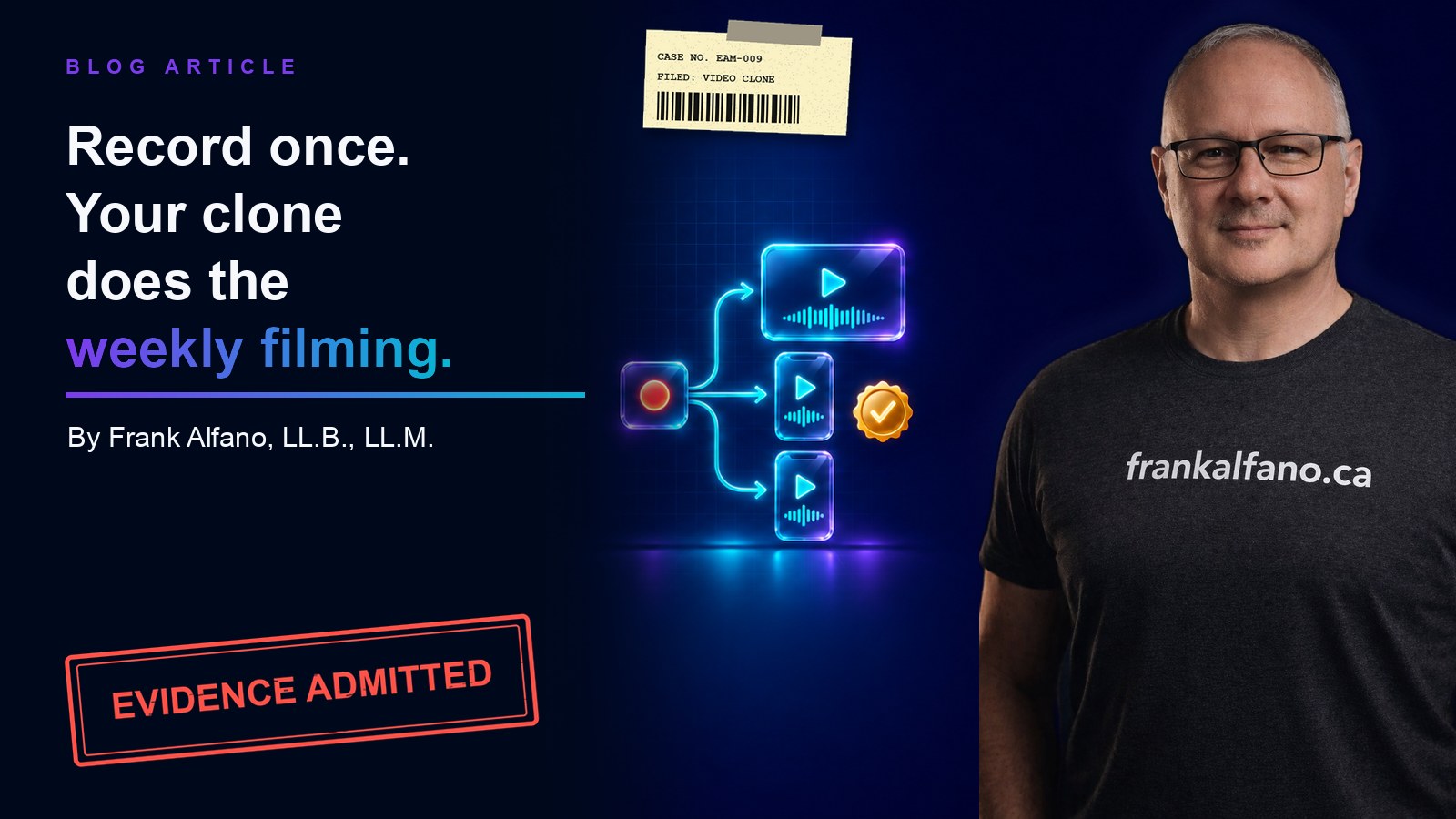
About 90 minutes in your office with our camera, or about 20 minutes with your own phone, can be the last time you stand in front of a lens to make a marketing video. Video cloning turns that one recording into an avatar and a voice clone of you, and from then on your clone presents the videos you approve.
That is our new digital cloning service at Exhibit A Media, for lawyers and paralegals, accountants, consultants, clinic owners and anyone whose expertise is what they sell. Here is how it works, what the rest of the market is doing, the honest case against avatars, and what it costs.
What our video cloning service does
You record once. From that recording we build two things: an avatar, which is a video model of your face and upper body, and a clone of your voice, which together make an AI clone of yourself that can present videos. They are a starting point for creating AI avatar videos and talking-head explainers, the kind of video where one person speaks to camera and explains one thing well. That format suits YouTube, TikTok and Instagram.
The Standard voice is a HeyGen voice clone. For a closer match to your accent and rhythm, the Premium option is an ElevenLabs Professional Voice Clone trained on 30 minutes to 3 hours of your speech. ElevenLabs' own Professional Voice Cloning documentation says "You can only create a Professional Voice Clone of your own voice," and it asks you to verify the voice before training starts.
One long video first, then the short ones
We start with long-form YouTube: a lesson, a lecture, an explainer, a video that teaches a viewer one thing properly. A paralegal on how a small claims case starts. An accountant on what to bring to a year-end meeting. A physiotherapist on what happens at a first assessment.
Then we cut it. Portions of the long video become short-form videos for TikTok, Instagram Reels, YouTube Shorts and Facebook Reels: your avatar talking to camera, B-roll scenes over your voice, and captioned highlights. A 20-minute lesson that answers six questions has six possible shorts inside it, and a viewer who likes one has somewhere to go next. It is the waterfall from how to repurpose one article into ten posts, pointed at video.
What agencies and platforms are doing with clones now
What is mainstream
Building an avatar from your own footage and voice, handing it a script and getting a captioned video back is now ordinary. In Wyzowl's 2026 video marketing survey, a small one at 266 respondents, 63% of video marketers said they have used AI video tools to help create or edit marketing videos.
HeyGen's April 2026 release added "multi-look generation, so you can select different outfits, settings, and styles from one base recording." Its May 2026 release says you can "Create AI videos, starring you in 177+ languages and dialects." For a Canadian practice, a clone recorded in English can deliver the same lesson in French.
What is leading edge
HeyGen's July 2026 release says its model "can now generate a single 30-minute AI talking video in one pass," aimed at anyone who makes "courses, training modules, or long explainers." The May 2026 release says "Your Twin can now hold a live, real-time conversation inside whatever you are building," and prices its newest avatar API at "five cents per second," which makes a separate video for every prospect technically possible. We found no professional-services agency selling either.
Where we sit
We use the mainstream tools for one job: long-form teaching, cut into short clips, presented by a clone the client has approved. We do not sell live avatars or one video per prospect. What we add comes before anything is rendered: our research pod starts with what your audience is searching for and asking about right now, and the scripts answer those questions in your voice. Writing scripts from search demand is our method, and we have not seen another studio publish it as theirs. We have already built demo clones for practising clients this way.
Why video belongs in a marketing plan
A clone is a tool. Whether it earns its keep depends on search, on social proof and on the plan that ties them together.
YouTube in search and in AI answers
You will hear YouTube called "the second largest search engine." We could not trace that line to any published measurement, and we found no figure from YouTube for how many searches it handles, so treat it as shorthand. What can be measured points the same way. Ahrefs' list of the 50 most-cited websites in Google AI Overviews, updated 3 November 2026, puts YouTube first, "capturing 24.5% of citations."
That is YouTube's share of the citations going to those top 50 websites, on US searches, so it is neither a Canadian figure nor a share of every citation Google shows. It still means your YouTube lesson can be the source an AI answer points to. We explain why that matters more than a ranking in you can rank #1 and still lose the client.
Short clips as proof you are real
Referrals still bring work, and then the client looks you up. A 2025 survey of 3,000 US consumers found that 74% of legal clients research firms after a referral, and that "nearly 60% of consumers say online reviews now carry more weight than word-of-mouth."
Those are American legal consumers. We looked for a Canadian survey on how clients check out any profession and found none, so a clinic owner in Burlington is reading US numbers like the rest of us.
They find your website, your reviews and whatever you have posted. A recent Reel that answers a real question shows a stranger how you explain things before they call. Know the limit: no study we found shows video outweighing reviews or a referral. Video supports the explanation, and the five-star review still does its own job.
The audience is there. YouTube's press page says "YouTube Shorts is now averaging over 200 billion daily views." We could not verify a current figure for Instagram or TikTok, so we quote none.
One part of a plan
A clone in a drawer does nothing. The videos have to answer questions people search for, link back to your website, feed the social calendar and line up with your articles. That is marketing, and it is why the clone sits inside our marketing services. The longer version of that argument is in why a website and marketing are not the same thing.
Building a brand, and what the work consists of
Most web developers use the word "branding" now and then. You do not often see them help anyone create and build a brand. On a website proposal, branding usually means a logo, a colour palette and a pair of fonts. Those are worth getting right, and they are the brand's clothes.
For a professional, the brand is what a stranger believes about you before you meet: what you know, how you explain it, and whether you sound like someone they could sit across a desk from. You build that belief by turning up with the same face, the same voice and useful answers until people recognise you. That is a list of jobs, and a logo is not on it:
- Choosing the subjects you want to be known for, and dropping the rest.
- Researching what your audience is searching for right now.
- Writing scripts in your voice, from your expertise, with a hook in the first seconds.
- Keeping a recurring format, so a viewer knows what they get from you.
- Planning each scene, from avatar to B-roll to captions.
- Cutting each long video into platform-ready shorts and scheduling them.
- Getting your approval on every piece, so the brand stays yours.
- Checking what worked, then making more of it.
That list is the work, and we do it where others don't. For anyone who bills by the hour, it usually breaks at the filming: booking a room, setting up lights and doing a fourth take of a sentence you got right the first time. The clone removes the filming. We do the rest of the list.
The honest case against AI avatars
Here is the evidence that cuts against us. In two online experiments with 656 and 769 participants, published in Behavioral Sciences in 2026, a human presenter in short retail product videos beat captions alone in the first and an AI avatar in the second, and "enhanced attitudes toward the video, perceived usefulness, trust, and purchase intention". Those were retail ads, but the direction is plain.
A second study, Through the Looking-Glass, ran two preregistered experiments with 2,000 participants watching truthful and deceptive speakers on video. Perceived trust and confidence in judgements fell when the video was AI-mediated, and fell most when some speakers used avatars and others did not. Accuracy did not change: viewers caught lies at the same rate and were no more likely to suspect the AI-mediated speakers of lying.
That mixed case describes most practices with a clone, which show their real face in some places and the clone in others. Neither study tested what we make: a disclosed clone of a real, named professional presenting their own approved material. We looked for that study and found none, so we will not claim a clone performs as well as you in person, or worse.
Quality is where a clone wins or loses. In the same Wyzowl survey, 89% of consumers said video quality affects their trust in a brand. A clone that looks slightly off costs more than it saves.
What we do about it
- The clone presents your expertise, from a script you approved.
- Every cloning attempt goes through quality assurance: footage review, consent check, clone build, a 6-second test clip, our review, your approval, then the first long-form video.
- The test clip is where we check the eyes, expression, lip sync and voice. If a recording will not produce a clone that looks and sounds like you, we tell you what to re-record.
- You approve the clone, and then you approve every video. Nothing is published under your name without your sign-off.
- Your consent is on file: a consent clip and a signed release. The platforms check too: HeyGen's guide to creating a digital twin asks for a "short webcam verification video," and ElevenLabs only clones your own voice.
- We delete your raw recordings 30 days after the clone is verified.
Disclosure, and why we label our clone videos
YouTube's help page on disclosing altered or synthetic content says, "We require creators to disclose AI-generated or altered content that seems realistic." Creators must disclose content that "Makes a real person appear to say or do something they didn't do" or "Generates a realistic scene that didn't actually occur." The same page lists "Cloning one's own voice to create voice overs or dubs" as a change that does not need a label.
Here is the gap. The page says nothing about a realistic avatar of you reading a script you wrote and approved. You chose every word, yet no camera rolled, so the video is arguably "a realistic scene that didn't actually occur." YouTube's text does not settle it. YouTube's March 2024 announcement also says "YouTube may add a label even when a creator hasn't disclosed it," and that videos on topics "like health, news, elections, or finance" get "a more prominent label on the video itself." Clinics and accountants work inside that list.
TikTok's November 2025 newsroom post is shorter: "We require people to label realistic AI-generated content on TikTok." It enforces that with creator labelling tools and its own detection models.
So we disclose. Where a platform requires a label, your clone videos carry one, and where a rule is unclear we read it as asking. A label you chose looks better than one a platform added for you.
Video cloning cost, and two ways to get cloned
All prices are in Canadian dollars, plus HST. Both setups include your avatar and a Standard voice.
We come to you for $1,500
We bring the backdrop, camera, lighting, microphone and teleprompter to your office, direct each take and check the footage on the spot. Plan on about 90 minutes. You read, we worry about the light.
The $500 more than recording yourself pays for that equipment and for someone who knows how to run it. We bought the backdrops, the lights and the camera and learned to use them so you don't have to. A well-lit, well-framed recording is what a good clone is built from. If you would rather come to our office, you can, for the same $1,500.
You record it yourself for $1,000
Recording yourself costs $1,000, which saves you $500. You read the instructions and upload your photos and videos on our video clone onboarding page.
On a phone, the avatar capture sheet takes about 20 minutes: four head-on photos (neutral, soft smile, big smile, serious), one 20 to 30 second orbit video around the front of your face, and one talking video of two minutes or more in a single take. Use the back camera, hold the phone vertical, and record in 4K at 30 fps. Then record a consent clip of under 30 seconds. For a full session, the recording guide asks for a 2 to 5 minute continuous take. You can download the recording guide and the avatar capture sheet from our digital cloning service page.
What to know before you record
- Calm beats excited. The clone repeats your facial habits, so if you raise an eyebrow every time you make a point, your clone will raise it in every video you ever publish.
- Pause with your lips closed. Closed-lip pauses are what make the lip sync accurate.
- Only your voice on the recording. No receptionist asking about the 2 p.m., no dog.
- Say nothing confidential. The recording is source material for your clone.
- Send the original files, never a copy sent by text message.
What the videos cost after setup
| Item | Price (CAD, plus HST) |
|---|---|
| Short-form video using your clone | $150 each; your first five are $50 off each |
| Long-form YouTube video using your clone | $400 up to 10 minutes, $750 up to 30 minutes, $1,200 up to 60 minutes |
| Premium voice (ElevenLabs Professional Voice Clone) | Quoted with your setup |
There is no monthly video fee. Setup covers the clone, and you buy videos when you want them. The full list is on our pricing page.
Who makes your videos
Jana and I run production with AI production pods, each doing one job: research, script writing, scene writing, art direction and editing, and quality assurance. How two humans sit over that work is in how we work as an AI marketing agency with two humans in the loop.
The service is available whether or not we built your website, on its own or inside a wider marketing brief.
Where to start with video cloning
If you already know what you would teach, the camera is the only part left, and we can take it off your calendar. To talk through which subjects to start with and which recording option fits your office, book a consult with us.
Common questions
What is video cloning and how does it work?
Video cloning builds an AI avatar and a voice clone of a real person from one recording, so the clone can present new videos without that person filming each one. At Exhibit A Media, the clone presents long-form YouTube lessons and short clips cut from them for TikTok, Instagram Reels, YouTube Shorts and Facebook Reels. You approve the clone, then every video.
How much does a digital clone cost?
At Exhibit A Media, clone setup is $1,000 if you record yourself, or $1,500 if we record you with our equipment, both including your avatar and a Standard voice. A Premium ElevenLabs voice is quoted with your setup. Short-form videos using the clone are $150 each, with $50 off each of the first five. Long-form YouTube videos are $400 up to 10 minutes, $750 up to 30 and $1,200 up to 60. Prices are CAD, plus HST, with no monthly video fee.
Do I have to disclose an AI avatar on YouTube?
YouTube requires creators to disclose AI-generated or altered content that seems realistic, including content that makes a real person appear to say something they didn't. Its help page says cloning your own voice for voice-overs needs no label, but it does not address a realistic avatar of you reading your own script. Because the rule is unclear and YouTube may add a label itself, disclose.
Can someone else use my voice clone?
Not through us. At Exhibit A Media your clone is built only from your own recording, with your consent clip and signed release on file, and nothing made with it is published without your approval. The platforms add checks of their own: ElevenLabs only lets you clone your own voice, after a verification step, and HeyGen asks for a webcam verification video. We delete raw recordings 30 days after your clone is verified.
Will clients trust a video made by an AI clone?
The research is mixed and incomplete. One experiment found that a human presenter beat an AI avatar in retail product ads, and another found that AI-mediated video lowered perceived trust without changing how accurately viewers spotted lies. No study we found tested a disclosed clone of a real professional presenting their own approved material. Quality and honesty are what you control, so test the clone, approve every video and label it.
Want these in your inbox?
Roughly monthly. Unsubscribe any time.