Google's preferred sources button: what it does for a business site, and what it does not
One reader taps a button and tells Google they want more of your site in Top Stories. That is the whole mechanic. Here is what Google preferred sources does for a professional site, what it cannot do, and why the volume of opt-ins is not a ranking signal.
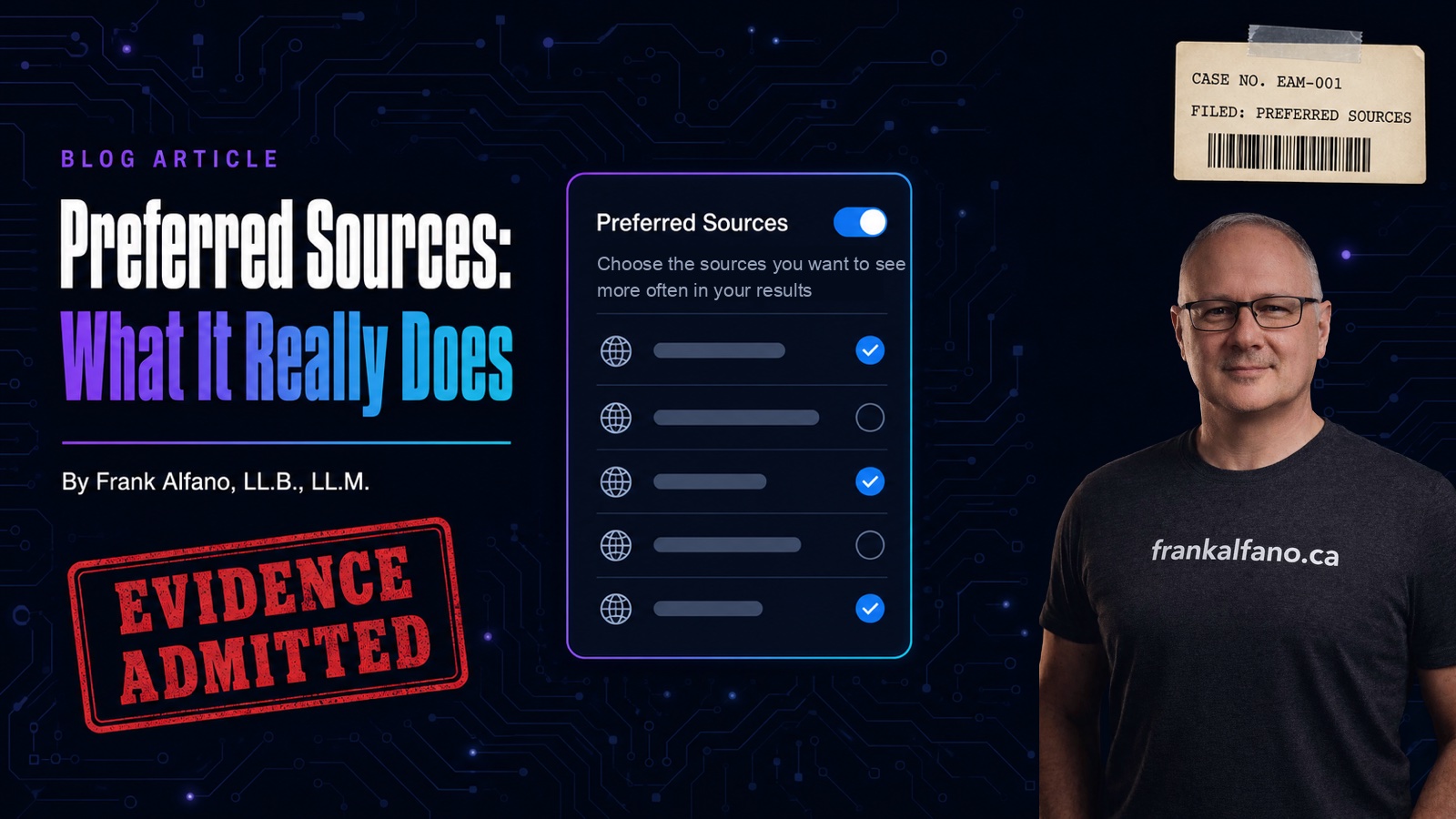
Google preferred sources is a switch on the reader’s side of the screen. Someone searching a news topic taps the icon next to Top Stories, picks the sites they want more of, and Google gives that person more of those sites. That is the entire mechanic, and it runs one account at a time.
That is also where the confusion starts, because anything that makes your name appear more often looks like a ranking feature. It is not one. Lawyers and paralegals ask me about this one most, and dentists, doctors, accountants and vets ask the same question in different words. The answer is the same for all of them, and it comes from reading what Google published rather than what somebody wants it to say.
What the preferred sources button actually is
Google launched the feature on 12 August 2025 in a post titled “How to select your preferred sources in Top Stories in Search”, launching in the United States and India. The description was plain: pick your sources and you will see them “more frequently in Top Stories or in a dedicated ‘From your sources’ section” on the results page.
The reader does the work. The choice rides on their Google account, so it follows them into any browser they sign into and follows nobody else anywhere.
Since 20 August 2026 there is a second way in. In “Personalize what you see on Google Search, News, Discover”, Google announced an interactive preferred sources button a publisher can embed on their own pages: a reader clicks it, the site joins their list, and they land back where they were reading. Google’s Search Central documentation puts the cost at two lines of HTML. That documentation also carries the limit worth knowing before you plan around it: “Only domain-level and subdomain-level sites are eligible to appear in the source preferences tool.” A blog living in a subdirectory cannot be chosen on its own.
What Google has actually published, in order
Four posts, four numbers, and not one ranking claim among them.
On 10 December 2025, Google reported “nearly 90,000 unique sources” selected and said that when someone picks a preferred source, “they click to that site twice as much on average”. On 30 April 2026, “Preferred Sources now available in all languages” took the feature into every supported language, reported over 200,000 unique sites selected, and repeated that readers are twice as likely to click through after marking a site.
On 27 May 2026, “New ways to find your favorite sources and original content in AI Search” brought preferred sources into AI Overviews and AI Mode, with links from your chosen sources labelled so they stand out, plus a carousel on developing topics. That post counted more than 345,000 unique sources. By the 20 August 2026 announcement it was more than 600,000.
Read the four together and the shape is obvious. Every post describes where a chosen source shows up for the person who chose it. Google has never called preferred sources an input to ranking, and this is a company that publishes ranking guidance at the drop of a hat. The silence is the finding.
What it does for a business site
It keeps a reader who already likes you. Somebody who read your piece on a duty of care, a root canal or a payroll deadline can tell Google to bring you back, and Google’s own figure says that person returns at roughly twice the rate. Retention is underrated in professional services, where the buying window opens years after the reading window.
It also reaches the AI surfaces. Since May 2026 a chosen source gets labelled inside AI Overviews and AI Mode, which is rare presence inside an answer a machine wrote.
And it costs two lines of HTML. I run more than 40 live sites on Django and Hetzner, and on that stack the two lines go into one base template instead of onto every page by hand. I will install anything that cheap, the same way I will tell a client not to buy the expensive thing when the cheap thing does the job.
What the preferred sources button does not do
Now the larger half, where it gets sold badly.
It sits outside ranking entirely. Being selected changes your position for a stranger on no query, on no day. Google’s ranking systems and Google’s personalization settings are separate machinery, and no volume of the second feeds the first.
It does nothing in ordinary results. The feature lives in Top Stories, in the “From your sources” panel and in the labelled links inside AI experiences. The ten blue links your clients scroll through are untouched, and ranking well there is still earned the slow way, which I covered in answer engine optimization and featured snippets.
It is worth nothing from a reader who never opted in. Rank third and everyone sees you third. This one behaves more like a phone number: it works for the person who saved it and for nobody else.
It does not create eligibility you never had. Being selectable is a different thing from being surfaced, and Google’s Search Help is specific about the condition: “You’ll now find these sources more often in Top stories when they publish fresh content related to your search.” A dental practice that posts twice a year has nothing for Google to put in front of even a devoted opted-in reader. An accountant writing timely pieces through tax season has something. The button does not write the article.
It cannot be flipped on anyone’s behalf. No account setting a marketer can push, no bulk import. One person, one tap, their own account.
Why counting opt-ins is not an SEO win
Here is the pitch that has been going around, stripped of its packaging. Deploy the ask everywhere, get thousands of people to tap the button, and the total is supposed to become a ranking signal. Enough opt-ins, the theory goes, and Google reads the aggregate as authority.
The mechanism does not work that way. A preference is stored against the account that set it and applied when that account runs a search. Ten thousand opt-ins produce ten thousand personalized results pages, each adjusted for the single person looking at it. No shared pool exists for those choices to drain into.
The nearest comparison I have is a TV remote. Ten thousand people can add your channel to their favourites and every one of them finds you faster tonight, while the broadcast schedule sits where it was. You did not win a better time slot, and the people who never touched their remote still have no idea you exist.
A business problem sits on top of the technical one. A call to action can only be answered by someone already on your page, so the whole campaign is spent on the audience you least need to reach. You are asking the people who already found you to help you get found, while the person searching for a paralegal at eleven at night has still never heard your name.
Volume looks like proof, which is what makes it sell. A screenshot of a big number persuades in a way a slow content programme never will, and a metric that climbs while your position stays flat is a hobby. It is the confusion I unpacked in you can rank number one and still lose the client. Being counted and being ranked are separate achievements.
Where the effort actually belongs
Install the button if you publish regularly. It takes a few minutes and it treats your best readers well.
Then spend the week on the work that reaches strangers. Publish the piece that answers the question clients ask you on the phone. Make the site fast and readable at eleven at night on a cracked phone screen. Get your name onto the surfaces where machines do the recommending, which I covered in how to get cited by ChatGPT, and run the search, answer and social work as one system, which is the argument in the intersection of SEO, AEO, GEO and social posts.
Preferred sources is a good feature wearing a discovery costume over a loyalty tool, and once you see it that way you will stop expecting it to do a job it was never built for.
If you want a straight answer about what is moving your rankings and what is decoration, book a call and I will tell you which is which.
Common questions about Google preferred sources
What is Google’s preferred sources button?
Preferred sources is a Google Search feature that lets a reader choose which sites they want to see more of in Top Stories. Google launched it on 12 August 2025 in the United States and India, then expanded it to all supported languages on 30 April 2026. Since August 2026 a site owner can also embed a button so readers opt in without leaving the article.
Is preferred sources a ranking factor?
No. Preferred sources is a personalization setting stored against one reader’s Google account, and it changes what that reader sees rather than where a site ranks. Google has never described it as an input to ranking in any announcement about the feature. A site with thousands of opt-ins ranks where it always did for everyone who has not opted in, and nobody else’s results move because of your choice.
Does the preferred sources button help SEO?
Not in the way SEO is usually measured. It does not lift your position in ordinary search results and it does nothing for people who never selected you. It does help retention: Google reported on 30 April 2026 that readers are twice as likely to click through to a site after marking it as a preferred source.
Can a small business appear in Google Top Stories?
It can be selected, because Google’s documentation says domain-level and subdomain-level sites are eligible to appear in the source preferences tool. Appearing is separate. Google’s Search Help says chosen sources show up more often in Top Stories “when they publish fresh content related to your search”, so a site that rarely publishes has nothing to surface.
How do I add the preferred sources button to my site?
Google’s Search Central documentation for preferred sources gives the code, and it is two lines of HTML: a script tag that loads the library and a div where the button renders. The site has to be a domain or subdomain, because a subdirectory is not eligible. If you cannot edit your own HTML, that is the bigger problem.
Does preferred sources affect AI Overviews?
Yes, for the reader who set it. Google announced on 27 May 2026 that preferred sources came into AI Overviews and AI Mode, with links from a reader’s chosen sources labelled so they stand out. That changes how those links look to that one person. It does not make a site more likely to be cited for anybody else.
Want these in your inbox?
Roughly monthly. Unsubscribe any time.